
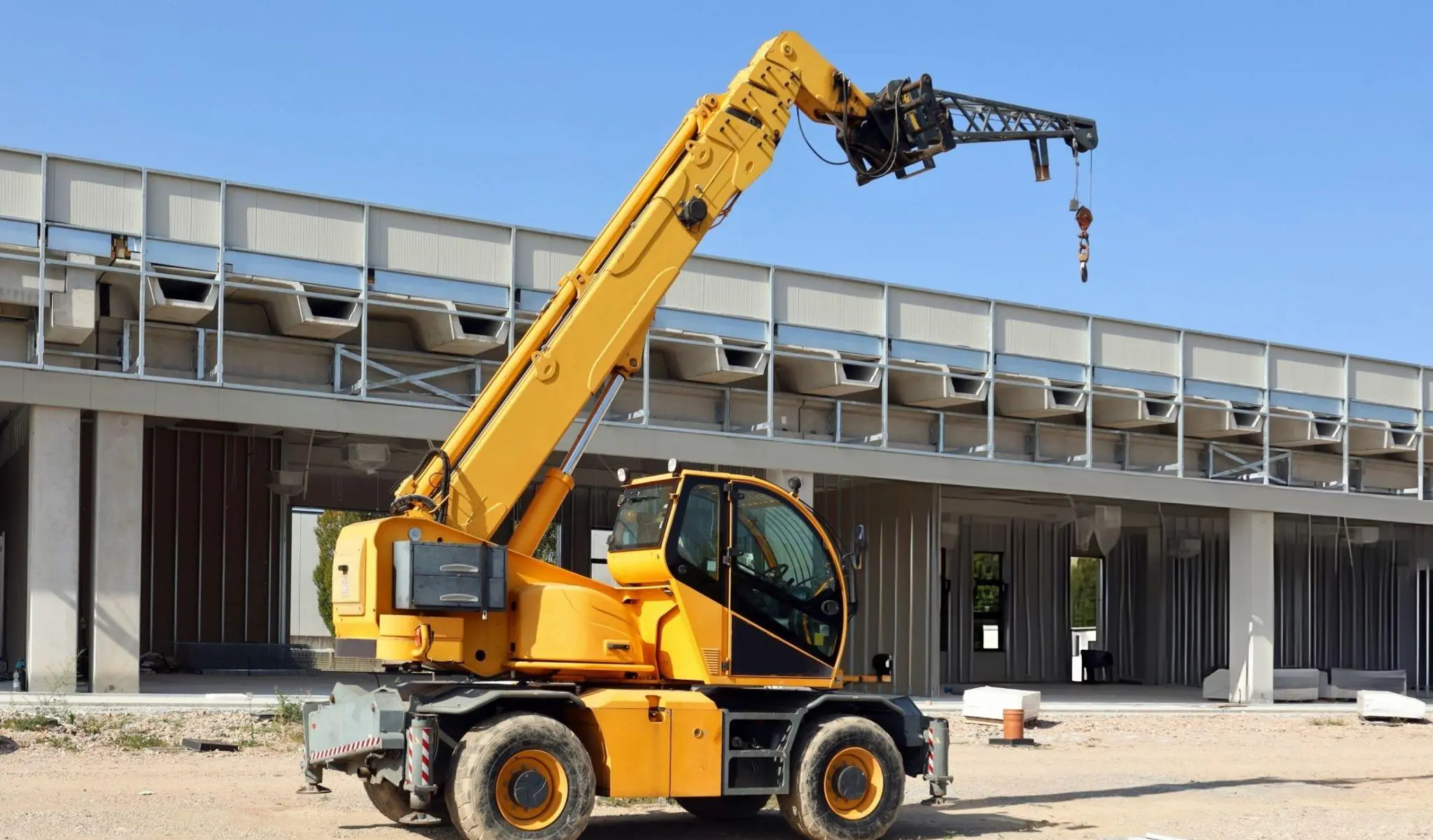
Heavy lifting is perhaps one of the most difficult jobs traditionally performed in construction, agriculture, warehouses, mining, and other industries. Although forklifts can easily lift and transport goods on level surfaces, there is a need for more versatile machinery capable of lifting and moving loads at higher elevations and on uneven terrain. This is where telehandlers take charge.
Combining the lifting capabilities of a forklift with the reach of a crane, this piece of equipment proves highly useful across various industries. You can use it to place construction materials, load farm products, or transport machinery on rugged ground. Telehandlers perform their tasks exceptionally well, increasing efficiency and ensuring safety on the worksite.
This guide will give you all the information you need on telehandlers, from their operation and types to their uses and advantages, along with helpful tips for choosing an appropriate model.
Key Takeaways
Without wasting further time, let’s highlight some important learnings that you will take away from this guide:
- Know what telehandlers are and the differences between them and conventional forklifts.
- Find out the mechanism of the telescopic boom system.
- Identify different kinds of telehandlers and their uses.
- Know the industries where the use of telehandlers yields maximum efficiency.
- Learn the key points to keep in mind when buying telehandlers.
- Understand why Big Boss Machines are considered to be the best sources for premium telehandlers.
What is a Telehandler?
A telehandler, also called a telescopic handler or reach forklift, is a piece of lifting equipment used to lift and carry materials into the air or to hard-to-reach places. The telehandler combines features of both a forklift and a crane, making it one of the most versatile machines commonly used on construction sites today.
In contrast to a traditional forklift, which can only lift loads vertically, telehandlers have telescopic booms that allow them to lift both vertically and horizontally. Thus, a telehandler makes it possible to maneuver cargo around barriers, up to roofs, the second floor, scaffolding, or any other elevated position with great accuracy.
Also, modern telehandlers allow for various attachments such as:
- Forks
- Buckets
- Jibs
- Hooks
- Working platform
- Hay balers
Thus, a single machine can be used for multiple purposes, reducing equipment costs and increasing productivity.
How Does a Telehandler Work?
From the outside, the telehandler looks very similar to a forklift. But the telehandler’s design is much more complex, as it can do things that regular material-handling machines cannot. The main element here is a telescopic boom that extends both outward and upward using powerful hydraulic cylinders. Depending on the telehandler type, its boom can be raised quite high above the ground with the help of a special counterweight system. A typical telehandler work cycle includes:
Engine and Hydraulics
First of all, an efficient diesel engine drives the hydraulic system that extends and retracts the boom and lifts and lowers it. It works smoothly no matter how heavy the load is.
Telescopic Boom
The boom itself is composed of several sections stacked one inside another. Both the height and forward reach of the boom can be adjusted depending on the weight and situation.
Stabilizers
Large telehandlers have hydraulic stabilizers or outriggers that extend outwards to aid balance when lifting heavy loads.
Quick-Attachment Coupler System
The quick-attachment couplers allow operators to change attachments in a matter of minutes, completely changing the equipment’s application.
Four-Wheel Steering
Most telehandlers come with different types of steering, including the following:
- Front-wheel steering
- Four-wheel steering
- Crab steering
These steering options significantly improve maneuverability in confined job sites.
Main Components of a Telehandler
All telehandlers have major components that help operate the equipment efficiently and safely.
Boom
The boom is the most important part of the telehandler. It has multiple extensions that provide sufficient height and forward reach, which is impossible for a traditional forklift. The boom is made of steel and supports a variety of attachments, such as forks and buckets.
Chassis
There is a very durable steel chassis. The chassis can carry heavy loads and withstand rugged conditions on construction sites and farms.
Hydraulics System
The hydraulic system operates all boom functions, including extension, tilting, and attachment control. This system includes pumps and cylinders.
Counterweight
It is located at the rear of the machine. It helps balance heavy loads when the boom reaches its maximum length.
Cabin
Nowadays, the operator cabin features a digital display, comfortable joysticks, air conditioning, and a load monitoring system.
Tires
Large all-terrain tires provide strong traction and flotation on rough surfaces, enabling effective performance across construction sites, farms, and industrial yards.
Types of Telehandlers
Not all telehandlers serve the same purpose. Different manufacturers manufacture various types based on the lift capacity, boom length, and application.
Compact Telehandlers
Compact telehandlers suit environments that require extensive maneuvering.
Some of the uses are:
- Warehouses
- Landscaping
- Construction on residential buildings
- Industrial work inside a factory
With their compact sizes, telehandlers move easily while offering maximum lift capacity.
Construction Telehandlers
Telehandlers are among the most widely used equipment on construction sites. Their applications are:
- Carrying bricks
- Transporting steel structures
- Lifting concrete
- Roof construction
- Building multi-storey structures
These telehandlers offer high lift capacity combined with long boom reach.
Heavy-Duty Telehandlers
Heavy-duty telehandlers are designed to serve industries that require lifting capability.
Application Areas Include:
- Mining
- Ports
- Construction
- Oil and Gas Industry
- Big industrial sites
Such telehandlers aim to deliver the highest lifting capacity while remaining stable in difficult conditions.
Rotating Telehandlers
Unlike ordinary telehandlers, rotating telehandlers feature a boom that rotates up to 360 degrees. Benefits Include:
- Simplified positioning
- Quick placement of materials
- Increased efficiency
- Greater accessibility
Such machines are frequently used for special construction purposes.
When is a Telehandler Used?
The decision to use a telehandler can be based on the type of work being done. The telehandler is the best option when there is a need to raise and position items at heights that regular forklifts cannot reach. Common Uses for Telehandlers Include:
Multi-Level Construction
Telehandlers can stack construction materials such as blocks, bricks, and even beams directly onto scaffolding and upper levels, thus eliminating the need for cranes for most lifts.
Rough Terrains
The telehandler has large all-terrain tires and 4-wheel drive, enabling it to operate efficiently on rough, muddy, or uneven terrain.
Agriculture
Farming operations use telehandlers to lift bales, transport feed and fertilizer, load grain, and maneuver farm machinery.
Industrial Facilities
Manufacturing facilities use telehandlers to transport heavy machinery, pallets, and huge loads within the plant easily and efficiently.
Warehouses and Outside Storage Areas
These devices can be used to stack bulky goods at elevated heights where it is impossible to operate indoor forklifts.
Industries That Rely on Telehandlers
In the modern world, the use of telehandlers is becoming a necessity in many industries owing to their unique features: versatility, high lift capacity, rough-terrain operation, and a wide range of attachments. Key Industries Using Telehandlers:
- Construction: Commonly used in lifting and positioning of loads at tall buildings, scaffolding, and difficult construction sites.
- Agriculture: Farmers use them for handling bales, feeds, grains, and equipment around farms.
- Mining: Good for handling materials, maintaining equipment, and rough terrains of mining industries.
- Logistics/Warehouse: Great for stacking pallets, truck loading/unloading, and handling heavy materials in a large outdoor storage yard.
- Manufacturing: Useful for the movement of machinery, components, and raw materials in manufacturing plants.
- Infrastructure development: Essential for road works, bridge construction, and utility installation, where precise lifting is required on difficult sites.
- Ports and shipping: Assistance with loading and unloading of goods, container handling, and equipment movements at ports.
- Oil and Gas: Assist in maintaining rigs, handling pipes, and transporting materials to distant sites under difficult conditions.
- Municipal Services: Employed by municipal authorities for waste disposal, repairs, and emergency services.
Being a versatile machine that can change attachments quickly helps reduce reliance on other machines.
Benefits of Using Telehandlers
More companies prefer telehandlers due to the many advantages that such machinery offers over other types.
Increased Height and Reach
The machines have impressive height and forward reach, enabling them to lift goods in areas that forklifts cannot safely reach.
Improved Efficiency
One piece of machinery will accomplish tasks that would require multiple pieces of machinery using fast-attachable tools.
Stability
With their advanced hydraulic systems and proper counterweights, telehandlers can operate safely even at maximum height and reach.
Flexibility
There is a broad array of attachments, making telehandlers easy to use for various purposes such as lifting, moving, carrying, digging, and positioning loads.
Decreased Equipment Cost
A business can use a single multifunctional telehandler rather than investing in multiple dedicated pieces of equipment, such as cranes, forklifts, and loaders.
Increased Job Site Productivity
Instead of hauling supplies by hand, they are brought straight to the point of use, minimizing manual labor and movement.
Choosing the Right Telehandler for Your Business
Choosing the best telehandler involves identifying your unique business needs rather than basing your choice solely on lifting capacity. The following are some important considerations:
- Lifting Capacity: Select a telehandler that is capable of lifting your heavy loads with a reasonable safety margin.
- Max Height: Ensure that the telehandler’s max height is in line with the highest point you need to lift materials to at your job sites.
- Forward Reach: Take into account your forward reach needs when placing loads at deeper points inside structures or past obstacles.
- Terrain Conditions: Go for all-terrain vehicles with 4-wheel drive and large tires for outdoor applications.
- Compatibility of Attachments: Choose a model that supports all the types of attachments you will need for your work.
- After-sales services: Go for a brand that offers quality after-sales support for maintenance and spare parts supply.
Safety Tips for Operating a Telehandler
It is as important to operate the equipment safely as it is to ensure its effectiveness. Compliance with safe procedures will prevent accidents and ensure the longevity of equipment.
Important Safety Procedures:
- Trained Operators — Only certified operators must use telehandlers.
- Inspection — Regular inspection of the equipment before each operation.
- Don’t Overload — Never ignore the maximum allowable load limits established by the manufacturer.
- Use Outriggers/Stabilizers — If you need additional stabilization, use outriggers/stabilizers.
- Maintain Balance — Load must be balanced and stabilized during any operations.
- Evaluate Ground Conditions — Check whether the ground is stable enough for operations and what type of slope it has.
- Check Locks — All attachments must be firmly secured.
- Guideline — Comply with all safety guidelines and the operating manual.
Using these tips will ensure your operations are performed safely.
Why Choose Big Boss Machines?
Procuring heavy machinery is not only about buying it but also about finding an organization one can rely on. Big Boss Machines provides its customers with reliable machines, competent advice, reasonable prices, and support services to help maximize efficiency.
Whatever it is that a company needs – a compact lifting machine or a heavy-duty telehandler for industrial applications, one can get the best SOCMA machines from Big Boss Machines. There is a wide variety of such machines that will help perform all the necessary lifting tasks: SOCMA 4 Ton 17 Meter Telehandler HNT4017-4Z, SOCMA 7 Ton 17 Meter Telehandler Forklift HNT7017-4Z, and SOCMA 11 Ton Telehandler Forklift HNT110.
Benefits of choosing Big Boss Machines include:
- The best machinery offered by reputable manufacturers
- Sound advice concerning telehandler selection
- Best after-sales services, including maintenance guidance
- The most durable equipment for the toughest industries
- Reasonable prices with the highest long-term value
With the appropriate equipment and services, a business can work much more efficiently.
Final Thoughts!
Telehandlers have proven themselves to be among the most versatile and useful machines today in construction, agriculture, logistics, mining, and industry at large. The ability to lift heavy loads to great heights, maneuverability on uneven terrain, and the versatility of attachment options have made them an economical choice for businesses looking to increase efficiency.
Regardless of whether you are managing materials on construction sites, loading agricultural products, or working on large infrastructure projects, your choice of telehandler can increase productivity and improve safety at your workplace. With the help of this guide, you will be able to better understand the various types of telehandlers, their operating mechanisms, and their suitable application areas.
With the best telehandler supplier in the UAE, Big Boss Machines and their quality telehandlers in the SOCMA series, you can perform difficult tasks with confidence.
Frequently Asked Questions!
The main function of a forklift is to lift loads vertically on level ground. At the same time, a telehandler has a telescopic arm that extends, enabling it to lift goods at elevated heights even on uneven surfaces.
Telehandlers have found applications in a variety of industries, including construction, agriculture, mining, logistics and warehousing, manufacturing industries, infrastructure construction, ports, and oil and gas installations.
Depending on the job, a telehandler can be equipped with several attachments, including pallet forks, buckets, hook lifts, jibs, work platforms, bale handlers, and other specialized attachments.
Many things need to be considered when choosing the right telehandler. These may include the telehandler’s capacity, lift height, forward reach, and more.
If you want to do heavy lifting with a telehandler, then you will do well with the SOCMA 11 Ton Telehandler Forklift HNT110. There are also other models, like the SOCMA 7 Ton 17 Meter Telehandler Forklift HNT7017-4Z and the SOCMA 4 Ton 17m Telehandler HNT4017-4Z, that you can consider if you need reach and lifting capacity.