
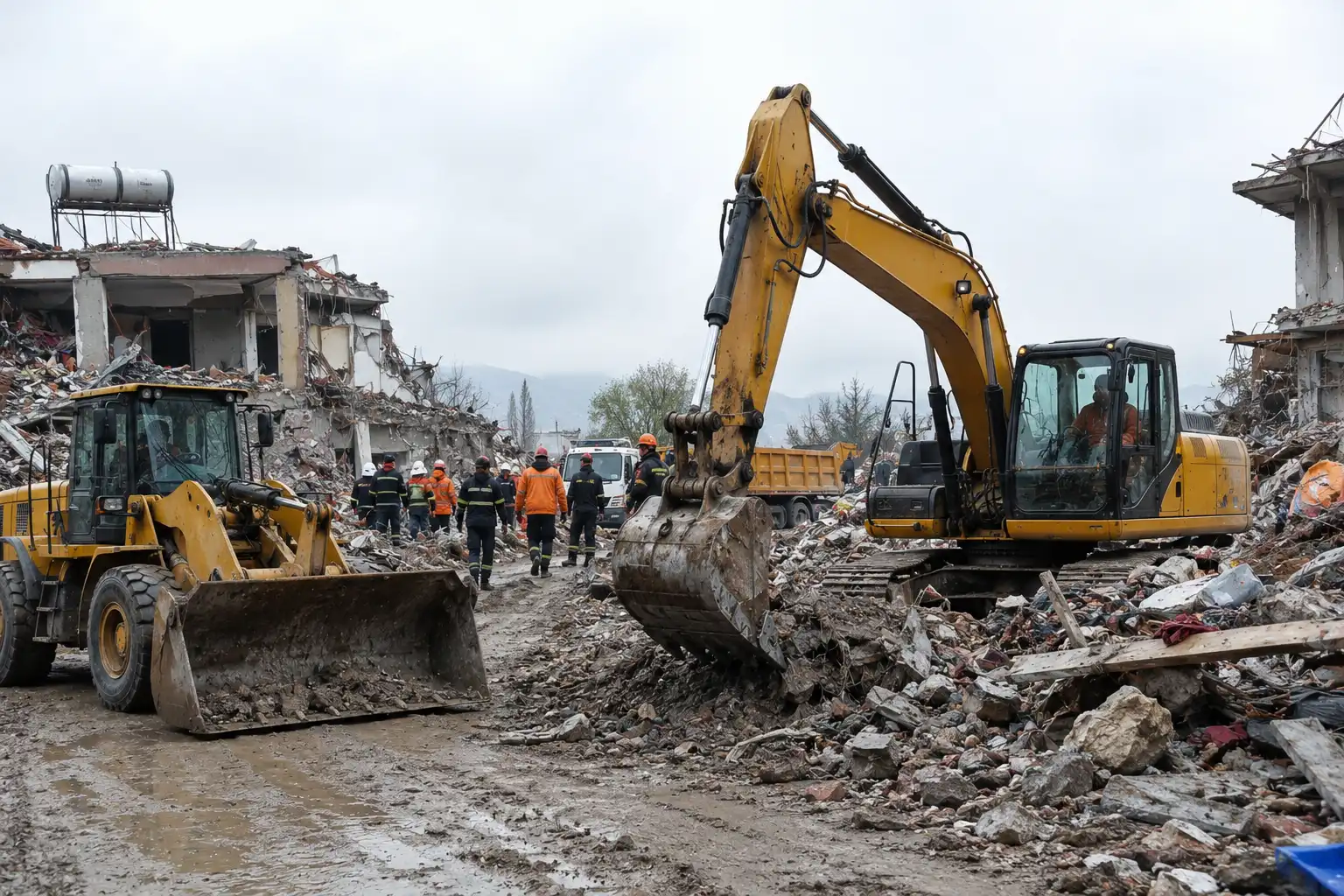
Time is of the essence in case of disasters and accidents. Whether it’s a flood, earthquake, landslide, fire, accident, or malfunction of industrial infrastructure, a fast and efficient disaster response will be crucial in saving people’s lives or preventing further losses. Regardless of the type of emergency, there should be professionals with the proper machinery to help them reach the site quickly and complete their tasks efficiently.
During emergency response projects, tasks may include clearing roads, removing debris, restoring important infrastructure, transporting supplies, and creating access to hazardous sites. These tasks require equipment that is effective, versatile, and designed to operate in difficult conditions.
The most popular emergency response equipment includes excavators, bulldozers, telehandlers, wheel loaders, light towers, air compressors, forklifts, cranes, and dump trucks. Each kind of machinery performs its own specific functions during emergency recovery projects.
This guide will explore the best equipment for emergency response projects and provide information about different kinds of machinery and what is needed to choose the proper equipment.
Key Takeaways
Emergency response construction projects need machines that complement each other.
- For removing debris and clearing the construction site, excavators, bulldozers, wheel loaders, and dump trucks are needed.
- Telehandlers, forklifts, cranes, and reach stackers are needed to lift and move materials.
- Motor graders and road rollers help restore transportation infrastructure.
- Portable lighting systems and diesel air compressors will allow you to carry on work despite the lack of electrical power at the construction site.
- Using effective machines will make operations more efficient and safer for the workers.
- It is important to invest in the appropriate machinery.
Why the Right Equipment Matters in Emergency Response
Emergency response projects are worlds apart from normal construction projects since it involves working against time under circumstances like damaged roads, unstable ground, poor visibility, and harsh weather conditions. The use of appropriate equipment helps emergency crews:
- Reach disaster sites quickly.
- Clear roads to the sites safely.
- Remove debris without further damage to structures.
- Restore basic services fast.
- Ensure worker safety in difficult conditions.
- Minimize delays in the project.
- Help with rescue, reconstruction, and rehabilitation all at once.
Heavy equipment in modern times has undergone great advancements and includes hydraulic systems, mobility features, fuel-efficient engines, and various attachments. Thus, it can be used in emergency responses as well as in recovery projects.
Key Challenges Faced During Emergency Response Projects
Each emergency brings along its own set of unique challenges, which will involve the use of more than one type of equipment. Some of the main challenges in emergencies include:
Limited Accessibility
A collapsed bridge, fallen tree, damaged roads, or landslides may make it hard for any vehicle used for rescue purposes to reach the area. This creates a need for equipment to improve accessibility.
Large Amounts of Debris
Disasters bring large amounts of debris, such as concrete, steel, timber, automobiles, and vegetation. Large amounts of debris require strong equipment that can handle different types of material.
Unstable Ground Conditions
Water and earthquake disasters usually cause unstable ground, meaning normal vehicles cannot drive on such terrain.
Time-Sensitive Operations
The whole essence of emergency services lies in timeliness. Having equipment that performs multiple tasks ensures faster project completion and increased efficiency.
Limited Visibility
Electricity is often switched off in such places during a disaster. Thus, portable light becomes a must for conducting rescues and recovery around the clock.
Best Equipment for Emergency Response Projects
No one machine can do everything when dealing with emergencies. In fact, the best way to respond to an emergency is through teamwork among equipment, making sure that all necessary tasks are performed as effectively as possible.
1. Excavators – The Most Important Equipment in Emergencies
Excavators play a key role in emergencies. Their flexibility makes them extremely important in clearing debris, digging trenches, demolishing buildings, and even performing rescue operations.
They come in different models and are equipped with different buckets and attachments like hydraulic breakers, grapples, and augers depending on their usage in the emergency.
Some of the main emergency uses include:
- Demolition of collapsed buildings
- Clearing roads obstructed by landslides
- Making drainage ditches in case of flood
- Performing search and rescue operations
- Moving debris to dump trucks
- Removing fallen trees
- Excavating utility pipes
While mini excavators are especially useful in urban areas with limited space, large crawler excavators are more suited for demolition works and removing debris.
2. Bulldozers – Fast Material Removal and Clearance
Bulldozers are made to clear large amounts of materials in very little time. The blades of the bulldozers enable emergency teams to regain access to the blocked roads or disaster sites quickly.
The superior traction that bulldozers have allows them to perform even on uneven surfaces such as mud and rocks, where other wheeled machinery would find it difficult to function.
Bulldozers are often used for:
- Removal of fallen trees
- Cleanup of landslides
- Creation of temporary roads
- Construction of fire barriers in case of wildfire
- Leveling of unstable ground
- Moving rubble from important infrastructures
These abilities make bulldozers one of the first machines used after natural calamities.
3. Wheel Loaders – Fast Material Handling
Wheel loaders are highly instrumental in facilitating quick movement of materials at emergency sites. This is because of their ability to load materials such as debris, gravel, sand, soil, and construction materials through high-capacity buckets much quicker than when carried manually.
Through speed and mobility, they enable operators to move materials from one point to another without the need for extra equipment.
The applications include:
- Loading debris into trucks
- Loading aggregate
- Cleaning damaged roads
- Storing emergency materials
- Reconstruction
- Sandbag loading during flood control
Contemporary wheel loaders have several attachments, which increases their flexibility in emergencies.
4. Backhoe Loaders – The Multi-Purpose Emergency Machine
Backhoe loaders combine digging and loading into one machine, making them well suited for emergency operations that require versatility. There is no need to transport many machines since backhoe loaders can handle multiple jobs with ease.
Some of the emergency response uses of backhoe loaders include:
- Repairing utilities
- Excavating trenches
- Maintaining roads
- Repositioning pipes
- Removing debris
- Excavation near buildings
- Site preparation
Moreover, their compact nature makes them suitable to operate in tight spaces in cities.
5. Skid Steer Loaders – Small Machine with High Performance
Skid Steer Loaders have the characteristic feature of being small machines with great maneuverability. They can be used in narrow city streets, neighborhoods, warehouses, and restricted disaster areas. The major strength of skid steers lies in the use of attachments.
Based on the needs of the operation, they can be equipped with:
- Buckets
- Sweeper
- Snow Blade
- Grapples
- Forks
- Augers
- Trenchers
- Hydraulic breakers
Thus, using just one machine can complete many operations without needing any other machinery.
The usual emergency operations performed are:
- Street cleaning
- Snow removal after storms
- Debris clearing
- Material transportation
- Utility repair assistance
- Cleanup
6. Wheel Excavators – Fast Response in Urban Areas
Wheel excavators are unique in that they can move around paved surfaces without damaging them, making them very useful for emergencies in urban areas. They are also quick to move from one place to another without needing transport.
Wheel excavators are suitable for use in:
- Urban infrastructure repairs
- Roadside emergencies
- Utility maintenance
- Drainage repairs
- Disasters in municipalities
- Bridge maintenance
They are effective in city emergencies due to their mobility and excavation capabilities.
7. Dump Trucks – Efficient Debris Transportation
Debris removal is not only a requirement, but so is transporting it away from the disaster site. Some of the major construction materials that are transported through the use of dump trucks include:
- Rubble
- Soil
- Sand
- Concrete
- Broken asphalt
- Vegetation
- Construction material waste
These dump trucks have high capacities and thus require fewer trips. They are used extensively to transport reconstruction material back onto the site.
Related: Largest Dump Truck in the World
8. Telehandlers – Reaching Difficult Areas
In emergency scenarios, there is usually a need to lift materials above destroyed structures or areas where normal forklifts cannot get to. Telehandlers possess both lifting capabilities and extended reach, making them very valuable in rescue and rebuilding efforts.
Some of their applications include:
- Providing construction materials
- Lifting generators
- Setting up temporary shelters
- Transporting heavy machinery
- Performing bridge repairs
- Loading platforms
Their telescopic boom allows for flexibility not possible with ordinary lifting equipment.
9. Forklifts – Supporting Emergency Logistics
The disaster response process is not only about cleaning up after the disaster. There is an equally important job of distributing food, medicines, water, equipment, and other necessary items. Forklifts make the logistics processes easier by transporting palletized products quickly and safely.
The main areas of application are:
- Loading relief vehicles
- Organizing emergency warehouses
- Moving medical supplies
- Transporting generators
- Transporting food and water packages
- Temporary distribution centers
Forklifts are very helpful in organizing the logistics chain during emergencies.
10. Mobile Cranes and Truck Cranes – Heavy Lifting Solutions
In case of an emergency, it becomes necessary to lift very heavy objects like collapsed concrete beams, damaged utility poles, shipping containers, steel structures, and bridge parts.
Mobile cranes and truck cranes offer the lifting power that is required to lift these heavy objects without posing any danger to rescue workers.
They are commonly used for:
- Clearing collapsed structures
- Erecting temporary bridges
- Lifting overturned trucks
- Repositioning utility poles
- Moving generators and machinery
- Rebuilding infrastructure
Because they can move easily from one place to another, they are very useful in emergencies across many disaster zones.
11. Mobile Light Towers – Keeping Operations Running After Dark
Situations do not get resolved just because darkness falls; rescue operations, clean-ups, repairs, and other necessary activities may need to continue during the night as well, so appropriate lighting is crucial for safety and efficiency.
Light towers are used to produce light in locations where the power supply has been affected, or the lighting system has been damaged. Mobile light towers can be brought to disaster scenes, temporary shelters, construction sites, and emergency command centers rapidly.
Popular uses include:
- Night rescue operations
- Construction of roads
- Emergency repairs
- Disaster relief camps
- Temporary hospitals
- Utilities maintenance
- Construction of temporary infrastructure
Light towers have been created with transportability, ease of set-up, and extended working time in mind.
12. Diesel Air Compressors – Powering Essential Equipment
Some emergencies rely on pneumatic devices that will need a steady flow of compressed air. This is where air compressors come in handy, powering various machinery when electrical energy is unavailable.
They are portable enough for use in emergencies in locations that cannot tap into normal power supplies.
The uses of air compressors include:
- Working jackhammers
- Crushing concrete
- Road repairs
- Pipeline repairs
- Utility restoration
- Sandblasting buildings
- Cleaning heavy equipment
Portable diesel air compressors are useful because they can be moved easily and start working right away upon reaching their destination.
Also Read: How Air Compressors Work?
13. Motor Graders – Restoring Roads and Access Routes
Floods, earthquakes, storms, and landslides can take a huge toll on road infrastructure. But before any emergency aid can be supplied to the disaster areas, the roads must be fixed and leveled. Motor graders are specially made to provide a smooth, stable surface.
Some of their uses include:
- Leveling temporary roads
- Rebuilding damaged highways
- Fixing gravel roads
- Improving drainage gradients
- Preparation of the site for rebuilding
- Creating access tracks
Their precision leveling is key for safe transport of relief teams and supplies.
14. Road Rollers – Strengthening Temporary Infrastructure
Following road repair and development of temporary roads, they need to be well compacted to support heavy emergency equipment. Road rollers compact soils, gravels, and asphalt to produce sturdy roads which enhance road safety and minimize future maintenance.
Common applications include:
- Temporary road compaction
- Flood-damaged areas stabilization
- Construction platform preparation
- Road rehabilitation
- Infrastructures rebuilding
- Reconstruction of airport runways following emergencies
Road compaction enhances the longevity of emergency road repairs.
15. Reach Stacker and Container Handler – Emergency Logistics Management
In cases of big disasters, there will be a need to move containers loaded with humanitarian aid, medicines, food, and equipment in a very short time. This task can be easily done by a reach stacker and container handler since they facilitate the handling of heavy cargo ships.
Reach stackers and container handlers are especially helpful in ports, logistics centers, warehouses, and emergency relief centers.
They are applicable for:
- Relief containers management
- Cargo loading/unloading
- Logistics yard management
- Humanitarian management
- Reconstruction materials management
Container management becomes effective with reach stackers and container handlers.
16. Concrete Equipment – Rebuilding Critical Infrastructure
After the immediate crisis is handled, repairs begin. Concrete machinery is an important element in repairing roads, bridges, drains, hospitals, educational institutions, and civic establishments. A good concrete machine will help repair vital infrastructure quickly and ensure quality construction.
Examples of concrete machine uses are:
- Repairing roads
- Repairing bridges
- Building retaining walls
- Repairing civic buildings
- Foundation works
- Drainage system repair
Speed and efficiency in placing concrete will ensure rapid recovery after a disaster.
How to Choose the Right Equipment for Emergency Response Projects
The choice of equipment will depend on the type of disaster, the landscape, the size of the project, and other operational considerations. Instead of focusing on one machine, effective emergency response calls for several complementary pieces of equipment.
Some of the issues to consider when selecting equipment include:
Nature of the Disaster
Different disasters call for different pieces of equipment. Floods, earthquakes, landslides, fires, and industrial accidents are some examples of disasters that demand different equipment.
Accessibility of Site
Whether an urban site, mountain, mud, or confined space, equipment choice will depend on the accessibility of the project site. Small equipment works best in difficult spaces, whereas large equipment will be needed to clear large amounts of debris.
Versatility
Machines that accommodate different attachments can carry out various activities and, as such, will not require any other piece of equipment.
Mobility
Equipment which can shift rapidly from one location to another will help minimize time delays and enable more than one activity to be carried out at the same time.
Safety Equipment
New machines fitted with improved visibility, safety equipment, stability controls, and monitoring equipment ensure increased safety in dangerous work environments.
Reliability
In emergencies, equipment that can function consistently without much interruption is essential. Well-maintained machines achieve this reliability.
The Role of Technology in Modern Emergency Response Equipment
The advancement of technologies in construction equipment has completely revolutionized the way emergency response is conducted. Machines today are manufactured to be smart, efficient, and easy to operate in challenging conditions.
Some of these new technological advancements are:
- Machine Positioning using GPS
- Telematics
- Efficient fuel engines
- Remote equipment diagnostics
- Hydraulic advancements
- 360-degree cameras
- Technologies to assist operators
- Performance monitoring
- Emission standard improvements
- Comfortable operator position for longer hours of work
These technologies help emergency teams work more productively, save fuel, minimize downtime, and make better decisions.
Why Choose Big Boss Machines?
Emergency projects require equipment that can handle the pressure and deliver reliably. This is because there is a lot to do at such projects and a lot that needs to be done quickly. Big Boss Machines provides all kinds of heavy equipment that can help with construction, infrastructure building, mining, material handling, and recovery work.
There are many different types of machines available in their inventory including excavators, mini excavators, wheel excavators, bulldozers, wheel loaders, skid steer loaders, backhoe loaders, motor graders, road rollers, telehandlers, forklifts, reach stackers, container handlers, truck cranes, rough terrain cranes, dump trucks, mining trucks, mobile light towers, diesel air compressors, concrete equipment and many more attachments for different jobs.
Final Thoughts!
Emergency response projects demand quick action, accuracy, and reliable equipment to cope with difficult situations and restore normalcy as soon as possible. Whether one has to clean debris, repair damaged infrastructure, transport relief goods, or rebuild communities, each step requires appropriate equipment.
A diversified equipment park including excavators, bulldozers, loaders, graders, rollers, cranes, telehandlers, forklifts, dump trucks, air compressors, and light towers enables efficient coping with any situation.
With the help of such equipment together with the use of the most recent technologies and appropriate planning, organizations will be able to increase efficiency, improve workers’ safety, and move on with emergency response much faster. Purchasing reliable heavy equipment is not just an investment in projects but also in community recovery.
Commonly Asked Questions!
The most common types of machinery include excavators, bulldozers, wheel loaders, skid steer loaders, dump trucks, telehandlers, forklifts, cranes, motor graders, road rollers, mobile light towers, and diesel air compressors. Each machine has a specific role in rescue, cleanup, logistics, and rebuilding.
Excavators are flexible machines that can be used for debris removal, digging, demolishing damaged infrastructure, clearing obstacles, and search-and-rescue activities. This is because they can accommodate various attachment tools.
Mobile light towers provide powerful lighting in areas without a power supply, ensuring that rescuers and builders can operate at night or in poor visibility conditions.
Telehandlers are used to lift and place cargo, move supplies, place machines, and access areas. The telescopic boom makes them perfect for use in disaster recovery and restoration.
Dump trucks are used to move the debris, rubble, soil, vegetation, and construction waste from the area, as well as move necessary materials for the reconstruction process.
GPS, telemetry, advanced hydraulics, remote diagnostics, and 360-degree cameras are examples of technologies that improve machine performance and make their work more efficient and effective.