
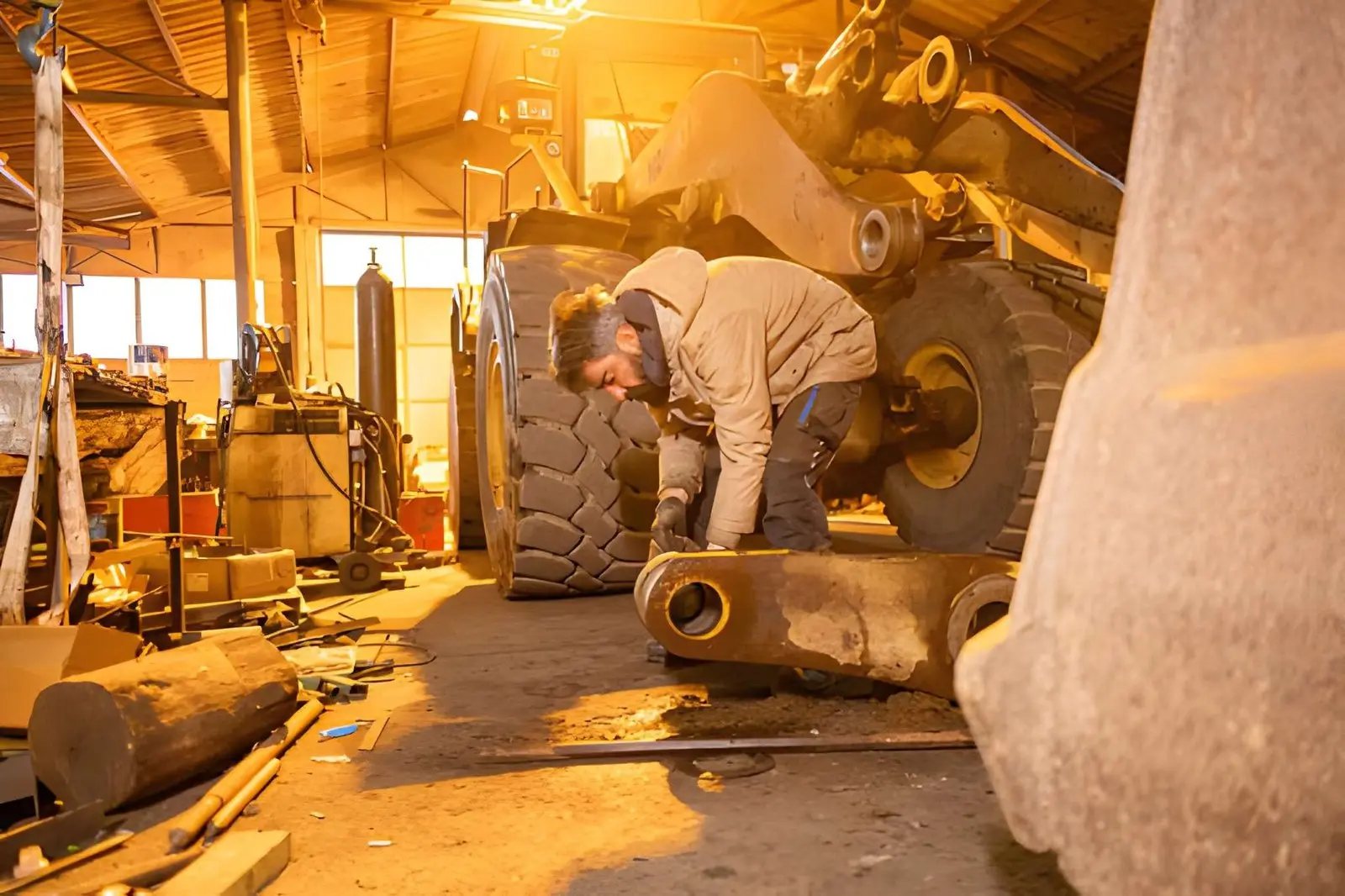
Even the most durable excavators, bulldozers, wheel loaders, forklifts, or cranes will need spare parts at some point in their lifespan. Yet choosing a suitable replacement component for your construction machine doesn’t end with finding a component that fits and is compatible. You need to find the right genuine heavy machinery spare part that can withstand the load.
Aftermarket and internet-based spare parts are becoming easier to buy. However, counterfeit spare parts have become a serious problem. A fake hydraulic seal, filter, bearing, brake component, or engine part may look acceptable upon delivery but can fail prematurely during machine use.
These purchases can increase spare-part costs and cause machine downtime, repair costs, reduced productivity, safety hazards, and additional damage to other components.
So, how can you ensure a heavy machinery spare part is authentic before you buy it?
This guide offers simple tips for recognizing counterfeit parts and avoiding the wrong choice.
Key Takeaways
Before we get into the details, here are the key points to keep in mind when verifying spare parts for your heavy machinery.
- Make sure you have verified the part number: A correct OEM/manufacturer part number is one of the strongest proofs of compatibility.
- Stick to reliable suppliers: Reputable dealers and machinery suppliers are usually easier to verify.
- Check the packaging and labeling: Poor print quality, grammatical errors on the label, or missing identification details can be red flags.
- Compare specifications: Compare the specifications such as size, rating, and limitations against the original part.
- Look for supporting documents: Invoices and warranties can help prove the part’s authenticity.
- Do not base your decision on price alone: A very cheap part can cost you more if it causes downtime or damage.
- When in doubt, go back to the manufacturer: The manufacturer or dealer may be able to verify the part number or the supplier’s legitimacy.
Why Authentic Heavy Machinery Spare Parts Matter
A heavy machine does not comprise mere components. The engine, hydraulics, transmission, electrical systems, undercarriage, braking system, and attachments work together within strict engineering tolerances.
An authentic spare part is built to match the exact specification required by the machine in question. A replica or poorly built spare part may look similar to the authentic part but uses poor-quality material, has the wrong dimensions, weak seals, or poor heat treating. These subtle differences can cause big trouble when the machine is working under load.
Use of authentic spares may assist in providing:
- More reliable machines: Parts made specifically for the machine are more likely to perform as expected, even in harsh operating conditions.
- Longer lifespan: Genuine parts typically meet the original equipment’s engineering and material requirements.
- Reduced downtime: Dependable parts decrease the likelihood of sudden malfunctions.
- Compatibility: Suitable parts integrate seamlessly with the machine’s hydraulic, mechanical, electrical, and electronic systems.
- Safety: Critical parts like brakes, steering system components, lift components, and hydraulic parts must function properly.
- Protecting other parts: An inferior part puts extra strain on connected parts, creating a cascading effect.
Cheap spare parts are not necessarily the most economical solution. The true cost includes installation, downtime, production losses, repairs, and failure risk.
1. Begin With the Machine and Model Itself
First, identifying the exact spare part requires knowing precisely which machine it should fit.
Heavy equipment manufacturers often produce several models that look similar but use different parts. Even different models in the same line can differ in their engines, hydraulics, transmissions, electrics, and production revisions.
Before you contact the supplier, try to collect as many details about your machine as possible. Such as:
- Manufacture and brand name: Identify the original equipment manufacture.
- Model number: Collect the whole number instead of an abbreviation.
- Serial number: The serial number may help you identify the machine’s exact revision.
- Year of manufacture: Old and new revisions might use different parts.
- Engine number: Very important when buying engine-related parts.
- Old part number: Write down the part number if it’s on your old part.
- Configuration: Attachments, hydraulic systems, and other configurations might affect the compatibility.
If a supplier starts asking for detailed machine information before recommending any parts, it usually means they are much more professional than those who say, “Yes, this will fit.”
2. Verify the OEM Part Number
The part number can prove to be your biggest asset when shopping for spare parts for heavy machinery.
Manufacturer-assigned identification numbers help differentiate one component from another. Rather than basing your decision on how the part looks, compare the number with authentic documentation from the manufacturer, parts catalog, service manuals, or an authorized dealer.
Pay close attention to every character. A fake part may bear a number that differs from the original by only one character. This might prove hard to notice.
During part number verification:
- Match all the characters: Check all letters, numbers, hyphens, prefixes, and suffixes.
- Check superseded numbers: In case the manufacturer has changed the part number.
- Check applicability: Just because the number is genuine doesn’t mean it will fit any machine model.
- Compare catalog information: Use reliable parts catalogs and manufacturer documentation whenever it is possible.
- Inquire with the supplier: A good supplier should be able to explain the difference between your number and theirs.
Remember: The matching part number should not be your only authenticity check.
3. Examine the Packaging Carefully
Packaging is often your first clue that a spare part is genuine.
Original producers usually follow high packaging standards. This includes professional labels, logos, product descriptions, barcodes, printing, and packaging materials. In contrast, fake parts may mimic the packaging but have subtle differences.
To ensure a genuine part, check the following:
- Logo: It should be high quality, without distortions or incorrect proportions.
- Spelling: Mistakes in labels or packaging are suspicious.
- Part number: It should match the documentation you received with the product and the part inside the package.
- Barcodes/QR codes: Whenever applicable, check that the identification codes match the product information.
- Packaging quality: Look for damage, low quality, or inconsistencies.
- Labels/Seals: Missing security seals, inconsistencies in stickers, or evidence that packaging has been tampered with.
- Manufacturer information: This might include identification details, warnings, or product information.
One packaging flaw does not prove the part is counterfeit. The packaging can be damaged during transportation. Yet, multiple inconsistencies require more investigation.
4. Inspect the Spare Part Itself
If you receive the component, inspect it before fitting it.
This is especially true for expensive and critical spare parts. Compare the new component to the old one if you keep it. Check how the part is made, and do not just ask yourself whether it “looks good” or not.
Look for:
- Quality of casting and machining: The spare part must usually be high quality and consistent.
- Finishing: Poor, rough finishing can signal questionable manufacturing.
- Identifying marks: Look for the marks and numbers that identify the manufacturer.
- Fasteners and connectors: Check whether the threads, connector, and bolt pattern match the old one.
- Dimensions: Measure critical dimensions where appropriate.
- Appearance of the material: Discoloration, corrosion, and poor coatings can indicate a problem.
- Weight: A significant weight difference can point to a different material or manufacturing process.
- Seals and gaskets: Check whether they appear correctly manufactured and properly fitted.
Do not disassemble the sealed component just to look inside. Look and measure the visible parts and compare them to the old ones.
5. Compare Technical Specifications
A part’s authenticity does not depend solely on its appearance. A spare part may look the same as the original but have entirely different operational specifications.
For instance, a hydraulics unit may be expected to perform within a certain pressure and temperature range. Engine parts must have specific materials and dimensions. Filters should have a certain filtration and flow capacity.
Some of the specifications to check include:
- Dimensions and tolerances
- Operating pressure
- Temperature range
- Load capacity
- Material composition
- Flow rate
- Filtration capacity
- Electrical specifications
- Connection types
- Weight
- Performance specifications
Wherever possible, compare with technical information provided by the manufacturer. If a spare part meets all physical compatibility requirements but does not meet operational specifications, it is unsuitable as a replacement.
6. Investigate the Supplier Before You Buy
A spare part’s authenticity depends largely on the seller’s credibility. A reputable seller with clear business information and good customer service is more trustworthy than a non-reputable seller offering low-priced spare parts with no detailed company information. Research the seller before buying.
Think about:
- History of the business: How long has the seller been running?
- Product specialization: Does the seller regularly deal in spare parts for heavy machinery?
- Relationships with manufacturers: Is it an authorized dealer, distributor, or reliable independent supplier?
- Reviews: Try to find several opinions about the seller, not just one or two.
- Contact details: Does the company provide real contact details?
- Return and replacement policy: This means that the seller takes responsibility for their goods.
- Warranty: What is the warranty and whose is it?
- Documentation: Will the supplier give invoices and product documentation?
If a seller doesn’t provide company information or avoids questions about the part’s authenticity, think twice.
7. Be Suspicious of Prices That Are Too Good to Be True
Who doesn’t want to get great prices for their machinery maintenance? However, if something is too cheap, then it needs to be investigated.
Good machinery components have standard manufacturing costs, quality control, distribution, and warranty prices. If one seller offers the same genuine component at a much lower price than several reliable suppliers, there could be a reason.
This could be a:
- A clearance product
- An older but genuine part
- A surplus component
- A refurbished part
- An aftermarket equivalent
- A used component
- Or, in some cases, a counterfeit product
The point is to find out why the price is lower, not to assume it is a great deal.
Ask the supplier why the product is so cheap and whether it is OEM, aftermarket, refurbished, or used.
This is crucial.
8. Ask for Proof of Authenticity and Traceability
For expensive machinery parts, do not be shy about asking for documentation. Depending on the particular part and supplier, the following documentation can prove helpful:
- Original purchase invoices
- Certificates from the manufacturer
- Warranties
- Product identification documentation
- Serial/batch numbers
- Inspection certificates
- Technical documentation
- Documentation provided by distributors
- Traceability documentation
Not every spare part will have all types of documentation. The required documentation depends on the manufacturer, the spare part, and its use. Nevertheless, a professional supplier should be able to tell you what documentation is available and why.
For important spare parts, traceability becomes especially valuable.
9. Differentiating OEM, Aftermarket, and Used Parts
Just because it is not an OEM part does not mean it is counterfeit. This is one of the most important differentiations to make.
OEM parts are manufactured for, or sourced by, the original equipment manufacturer, or their distribution system, depending on how the company operates. Third-party manufacturers make aftermarket parts. They can be authentic replacement parts, providing a more economical option in some cases, but only if they meet the necessary specifications and fit the machine.
Used or refurbished parts are previously used parts that may have been tested, repaired, or rebuilt. The issue is when the dealer sells aftermarket, used, or refurbished parts and claims they are authentic new OEM parts.
To avoid any problems, all you need to do is ask:
- “Exactly what type of part am I purchasing?”
Getting a clear answer can prevent significant confusion later.
10. Check Manufacturer or Dealer Verification
Go straight to the horse’s mouth if the matter is important. If there is any doubt regarding a part number, mark, supplier, or component itself, approach the manufacturer or authorized dealer of the machine in question.
Give them:
- Machine model
- Machine serial number
- Part number
- Supplier details
- Pictures of the part
- Pictures of the packaging and markings
- Any other relevant documents
The manufacturer or authorized dealer may be able to confirm whether the part number is correct or whether the part is appropriate for that machine. This can be especially helpful when dealing with costly engine parts, hydraulics, electrical control systems, undercarriage parts, and safety equipment.
11. Use Pictures, but Don’t Rely Only on Them
The Internet lets you get spares from all over the world. At the same time, pictures can give you a false sense of security. A picture may show an authentic part, but the seller may actually send something else. If you buy parts online, you need to see real pictures of the part you’re buying, especially when buying expensive spares.
You need to see clear pictures of:
- Part number
- Manufacturer markings
- Packaging
- Labels
- Serial or batch information
- Connectors and fittings
- Overall construction
Don’t rely only on generic catalog pictures. Remember that no matter how authentic-looking the pictures are, they will never provide enough proof of authenticity on their own.
12. Check the Warranty and Return Policy
If a company truly believes in its products, it will know its warranty policy for parts and defective items.
When making a purchase, consider:
- The warranty period: How long is the warranty period for the component?
- Conditions of the warranty: What failures can be considered?
- Time limit of return: How long is there to file a complaint?
- Installation requirements: Does installation require a professional installer?
- Evidence: What evidence must be provided when filing a warranty claim?
- Replacement process: How is the replacement handled if the component is found to be defective?
The lack of a warranty policy doesn’t mean a product is fake.
13. Watch for Common Red Flags
Counterfeit and questionable spare parts tend to show themselves through a series of warning signs rather than a single flaw.
Watch out if:
- The product is unusually cheap with no explanation why.
- You’re pressured to buy right away before you can check the part.
- The supplier provides no part number.
- There are inconsistent markings – the packaging and the component itself don’t match up.
- The packaging itself looks poor – printing, labeling, seals appear suspicious.
- There is no documentation whatsoever.
- The part’s origin is unknown.
- The product description in the listing is vague and lacks technical detail.
- The supplier offers no warranty.
- Communications from different suppliers are inconsistent.
A single warning sign doesn’t necessarily mean there is something wrong. However, multiple warning signs do.
14. Be Extra Careful With Critical Components
Not all spare parts carry equal risk. A cosmetic component that could be counterfeit is clearly different from a questionable brake, hydraulic, steering, lifting, or engine component.
Take even greater care with critical performance or safety parts, especially regarding authenticity and specifications.
These could include the following:
- Brake parts
- Steering parts
- Hydraulic pumps and valves
- Hydraulic hoses and fittings
- Lifting parts
- Engine parts
- Transmission parts
- Electrical control units
- Structural parts
- Safety switches and sensors
The potential cost of failure may outweigh the initial cost savings.
15. Keep Records After Purchase
The verification process doesn’t end after you receive the part. Documenting the purchase and installation lets you trace it later if issues arise.
Documentation:
- Purchase invoice: Document the supplier information, date, cost, and part details.
- Part number: Save the number used to identify the part.
- Serial number/batch number: Always document this whenever possible.
- Communication: Save all correspondence with the supplier, including email exchanges and quotations.
- Warranty details: Document the warranty terms and certificates.
- Installation documentation: Include when and where the part was installed.
- Photos: Take pictures of the part and the packaging before installation.
These records can be extremely useful for warranty claims, maintenance planning, troubleshooting, and future purchasing.
A Simple Pre-Purchase Verification Checklist
Before clicking the “Buy” button, run a quick verification. The idea here is not to complicate every purchase you make. The goal is to create an easy process that helps you avoid costly errors.
- Find out the correct model and serial number of your machine.
- Identify the correct part number.
- Confirm the part’s compatibility with your machine.
- Find out whether the component is OEM, aftermarket, used, or refurbished.
- Verify the supplier’s reputation and qualifications.
- Compare technical specifications.
- Examine product markings and packaging.
- Get documentation/tracking information for the part.
- Compare prices from other reputable sources.
- Study warranty and return policies.
- Ask for pictures of the product if purchasing online.
- Consult the manufacturer/authorized dealer to clarify any doubts about the part’s authenticity.
It might take extra time, but it will save you time and money in the future.
Why Choose Big Boss Machines?
Buying heavy machinery is one thing, but buying it from the right seller is another. Big Boss Machines has a wide range of reliable heavy machinery suitable for construction, mining, material handling, and industrial applications.
Wide Range of Heavy Machinery
With Big Boss Machines, you will have no trouble finding the right equipment, as they have an extensive range of machinery in various categories such as:
- Excavators for digging, trenching, earthmoving, demolition, and other excavation activities.
- Bulldozers for grading, leveling, earthmoving, site preparation, and pushing large amounts of materials.
- Skid Steer Loaders for digging, grading, loading, handling materials, and confined-space work.
- Forklifts for practical material-handling used in warehouses, industrial settings, and loading sites.
- Telehandlers for lifting, moving, and positioning of materials at various elevations and distances.
- Air Compressors for pneumatic tools and machinery, construction sites, industries, and any equipment that uses compressed air.
- Tower Lights for creating reliable lighting at night for construction, infrastructure, mining, and outdoor construction projects.
Machinery for Various Industries
Industries such as construction, infrastructure, mining, warehousing, and many others use equipment from Big Boss Machines. Big Boss Machines offers a wide range of machinery across several categories. This helps businesses choose machinery based on the nature of their project, amount of work, and capacity required.
Quality-Focused Machinery Solutions
Buying heavy equipment is a major investment, so quality matters. Big Boss Machines ensures the equipment it supplies comes from reputable brands, offering clients machinery suited to challenging applications.
One Place for Your Equipment Needs
Instead of searching for multiple suppliers, business owners can explore Big Boss Machines’ extensive range of machinery. Whether it is an excavator, forklift, bulldozer, skid steer loader, telehandler, air compressor, or light tower, you’ll find machinery suited to a wide range of applications.
Final Thoughts!
Checking the authenticity of heavy machinery spare parts isn’t complicated. It all boils down to adopting a more rigorous approach when making purchases.
Heavy machines operate in harsh environments where even one tiny part can greatly affect performance. Selecting the correct, authenticated spare part ensures the machine’s safety and efficiency, reduces maintenance costs, increases productivity, and, for safety-critical parts, keeps the operator safe.
The best spare-part purchase decision is not always the cheapest. It is the one that gives you full confidence in the performance of the chosen part.
Frequently Asked Questions!
First, check the part number, machine suitability, branding, packaging, specifications, and supplier qualifications. For costly spare parts, seek documentation and verify the part directly with the manufacturer or dealer wherever possible.
Not necessarily. An inexpensive spare part could be a legal aftermarket, excess, clearance, used, or refurbished product. But if it appears suspiciously cheap, question the supplier about its source, condition, warranty, and specifications.
An OEM part comes from the supplier’s own distribution channels or is manufactured according to the manufacturer’s specifications, based on the manufacturer’s policy. An aftermarket part is produced independently. An aftermarket part is not necessarily counterfeit.
The part number uniquely identifies the component. The part number indicates whether the spare component belongs to a particular machine. Make sure to look at the full number, including prefixes, suffixes, numbers, and letters.
Look at the seller’s reputation, product description, exact part number, technical specifications, pictures, guarantee, return conditions, and documentation. Be very careful with an offer for an expensive spare part that is too cheap and has no explanation from the seller.
Yes, but it is possible. To authenticate the spare part, provide the machine model, serial number, part number, pictures, and supplier information.