
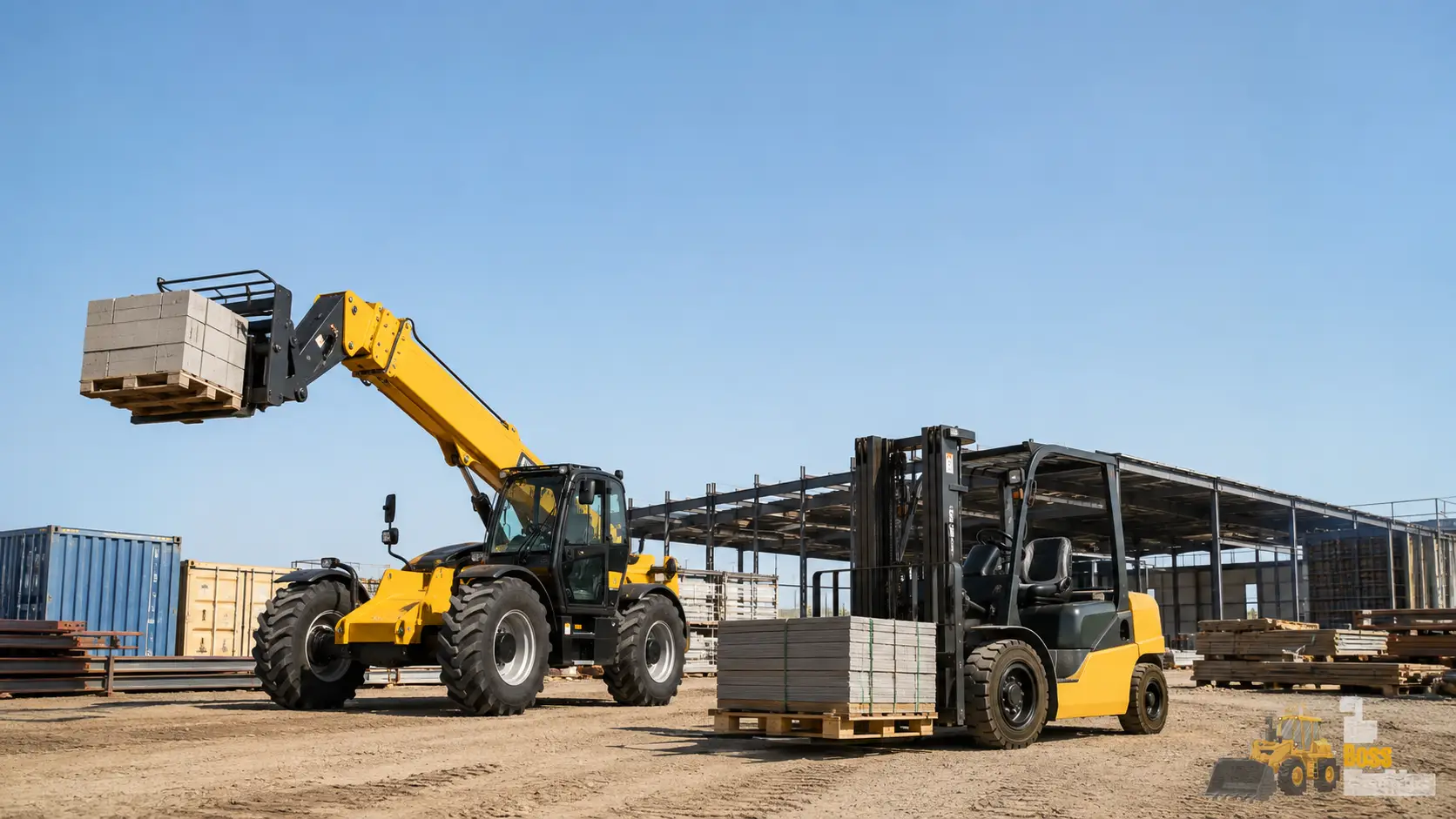
Material handling equipment has become an inseparable element of many industries, including construction, warehouse management, logistics, agriculture, and manufacturing. Depending on the nature of operations, one can encounter material movement and handling in various scenarios, from indoor pallet transport to lifting construction materials to elevated areas.
Among the various machinery involved in material movement and handling, telehandlers and forklifts are often considered the most similar. However, despite the visual similarities between these machines and their shared main functions, the purposes of the two pieces of equipment differ completely. A forklift is used inside buildings on flat surfaces, while a telehandler combines the functions of a forklift and a crane.
Key Takeaways
Selecting the right equipment for your project may influence not only your performance but also the safety of your work and overall productivity. The article below provides valuable information on two similar material-handling machines and the key differences to consider when choosing between them.
- Learn more about the key differences between a telehandler and a forklift, which include their design, functionality, and preferred environment of work.
- Find out the most common applications of these two machines to see which tasks a telehandler and which a forklift can be used for in different sectors.
- See the comparison of such important characteristics as lifting capacity, maximum reach, stability, maneuverability, terrain capabilities, and attachments.
- Get acquainted with the range of equipment offered by Big Boss Machines, including high-quality SOCMA Telehandlers and reliable forklifts suitable for industrial use.
- Discover the pros and cons of each machine to understand their value.
- Learn useful tips for buying a machine based on your project specifications and other factors.
What is a Telehandler?
A telehandler, also known as a telescopic handler, is a highly adaptable lift truck featuring an adjustable boom that can extend both upwards and outwards. The machine is unlike typical forklift trucks because telehandlers can deposit loads in high and distant locations, and they are thus vital in construction and agriculture.
The key strength of telehandlers is their versatility with a variety of attachments, including forks, buckets, hooks, work platforms, and grabs. In this way, a single machine can carry out the duties of several machines.
The key functions of telehandlers include:
- Transporting construction materials to upper floors
- Loading and unloading of heavy machinery
- Lifting of pallets over rough ground
- Agriculture
- Infrastructure development
- Mining and industries
- Maintenance of machines from elevated positions
What is a Forklift?
A forklift is an electric industrial truck designed to lift and move objects in enclosed spaces. The difference between a telehandler and a forklift is that a forklift uses a vertical mast instead of telescopic booms. For this reason, they are best suited for use in logistics centers, distribution centers, manufacturing facilities, and warehouses.
Some of the tasks that forklifts are suited for include:
- Managing warehouse inventory
- Shipping and receiving activities
- Manufacturing facilities
- Retail distribution centers
- Loading containers
- Material transportation
- Cold storage areas
Telehandler vs Forklift: Understanding the Core Differences
A telehandler and a forklift are indeed similar because they both are lifting machines. However, there are some other features in which they vary greatly from one another. It is essential to understand their differences and similarities to choose the right machine for the specific task.
| Feature | Telehandler | Forklift |
| Machine Design | Features an extendable telescopic boom that can lift loads both vertically and horizontally. | Uses a fixed vertical mast to lift loads straight up and down. |
| Lifting Height | Can lift materials to significant heights, making it ideal for multi-story construction and elevated work areas. | Offers moderate lifting heights, suitable for warehouse racking and pallet stacking. |
| Forward Reach | Excellent forward reach allows materials to be placed over obstacles or into difficult-to-access locations. | Very limited forward reach as the load remains close to the mast during operation. |
| Lifting Capacity | Available in high-capacity models capable of handling extremely heavy loads on demanding job sites. | Offers various lifting capacities, primarily designed for palletized goods and warehouse materials. |
| Terrain Capability | Designed to operate on rough, uneven, muddy, or rocky terrain with excellent stability. | Performs best on flat, paved, or smooth warehouse floors and concrete surfaces. |
| Attachments | Compatible with multiple attachments, including forks, buckets, lifting hooks, work platforms, grabs, and jibs, making it highly versatile. | Primarily uses forks, with limited compatibility for specialized attachments like clamps or rotators. |
| Indoor Operations | Can be used indoors if sufficient space is available, but its larger size may limit maneuverability. | Specifically designed for indoor warehouses, factories, and distribution centers with narrow aisles. |
| Outdoor Operations | Excels in outdoor environments including construction sites, farms, mining operations, and infrastructure projects. | Can be used outdoors on stable, level surfaces but is less effective on rough terrain. |
| Versatility | A multi-purpose machine that can perform lifting, loading, material handling, and elevated work using different attachments. | Primarily designed for lifting, transporting, and stacking pallets over short distances. |
| Maneuverability | Larger turning radius and size make it less agile in confined spaces. | Compact design provides excellent maneuverability in narrow warehouse aisles and tight spaces. |
| Stability System | Equipped with a wider chassis and, in many models, stabilizers or outriggers for safe lifting at height. | Relies on a rear counterweight and balanced load distribution for stability. |
| Speed of Operation | Slightly slower due to its size and focus on precision lifting and positioning. | Faster for repetitive loading, unloading, and pallet transportation tasks. |
| Best Industries | Construction, agriculture, mining, infrastructure development, ports, heavy industries, and equipment maintenance. | Warehousing, logistics, retail distribution, manufacturing, shipping, and cold storage facilities. |
| Maintenance | Requires more maintenance due to the telescopic boom, hydraulic systems, and multiple attachments. | Generally easier and less expensive to maintain because of its simpler design. |
| Initial Investment | Higher purchase cost due to advanced features, greater reach, and increased versatility. | Lower upfront investment, making it a cost-effective option for warehouse and industrial operations. |
| Operator Skill Level | Requires specialized operator training due to its lifting height, boom movement, and multiple attachment options. | Easier to learn and operate, though certified training is still required for safe operation. |
| Ideal Use Case | Best for lifting heavy materials to elevated or hard-to-reach areas on challenging job sites. | Best for efficiently moving, stacking, and transporting palletized goods within warehouses and industrial facilities. |
Telehandler Applications
A telehandler is manufactured for applications where height and reach become essential. Because of their ability to operate in tough terrain, telehandlers are a favorite among many industries.
Construction Sites
Construction companies can use telehandlers to transport bricks, steel rods, bags of cement, roof sheets, and pallets to areas that regular forklifts cannot reach.
Agriculture
Telehandlers are used on farms for transporting hay bales, bags of feed, and fertilizers, working in grain silos, and performing maintenance work, thanks to their off-road capabilities.
Mining Industries
Mining operations demand machinery capable of transporting heavy loads over tough terrain without losing balance, and telehandlers are ideal for such tasks.
Industrial Maintenance
Telehandlers with work platforms and lifting hooks are used in industrial and manufacturing facilities to perform high-place maintenance operations.
Infrastructural Development Projects
Large construction operations, including bridges, highways, airfields, and power plants, benefit from telehandlers for handling large loads.
Forklift Applications
Forklifts are still a vital part of indoor logistics, thanks to their speed, compact size, and ability to maneuver through narrow spaces.
Warehousing
Forklifts allow easier inventory movement, as pallets can be transferred between loading ramps, storage shelves, and areas for outgoing stock quickly and safely.
Manufacturing
Factories use forklifts to transport raw materials between different sections with the fewest man-hours.
Retail Distribution
Distribution hubs have forklifts running the daily operations – inventory management, order preparation, and warehouse optimization.
Cold Storage
E-forklifts are usually chosen for cold rooms and cold warehouses since they operate without generating pollutants and hardly disturb anyone with their sounds.
Shipping and Logistics
With forklifts, goods can be transferred to and from trucks, ships, and containers smoothly, with the least chance of mishandling.
Advantages of a Telehandler
A telehandler is designed for tough outdoor jobs that require both lift height and forward reach. With its telescopic boom and compatibility with many attachment options, it is among the most versatile material-handling equipment.
The following are some of the major advantages:
- High Lift Height: Can lift materials to rooftops and other high places.
- High Forward Reach: Enables it to clear any obstacle and position the load in difficult spots.
- Operation in Rough Terrain: It operates effectively on uneven, muddy terrain.
- Various Attachments Available: Forks, buckets, hooks, and work platform attachments.
- Higher Efficiency: Minimizes human labor and improves the speed of transporting materials to the workplace.
- Increased Flexibility: One machine can do a variety of lifting and loading functions.
- Precision Load Placement: Gives greater control when placing heavy loads at height.
Limitations of Telehandlers
Despite their versatility and lifting capacity, telehandlers may not be the best equipment for all tasks. The reason is the size of this machinery and the variety of its features, which make it more appropriate for certain sectors and environments. Some of the common disadvantages of telehandlers include:
- Expensive Price: Telehandlers are usually more expensive than forklifts due to their greater versatility in lifting.
- Requires a Larger Working Area: Telehandlers need a larger working area because they are bulky and have telescopic booms.
- Not Appropriate for Warehouse Work: Although telehandlers can lift pallets, they operate more slowly than forklifts and are less suitable for indoor warehouse spaces.
- Skilled Operators Needed: Operators should be able to perform their tasks safely due to the telehandler’s boom movement and lifting capabilities.
- Complex Maintenance: Regular maintenance of hydraulic systems and various booms is required.
Advantages of a Forklift
A forklift is commonly used in warehouses, factories, and logistics companies because it is designed to make material handling faster and more efficient.
The following are some of the main advantages of using a forklift:
- Compact Structure: A forklift can easily move in narrow aisles, racking units, and warehouse environments.
- Fast Handling: Forklifts are capable of fast loading, unloading, and pallet transfer.
- Low Operating Costs: Forklifts tend to be cheaper than other lifting and handling machines, such as telehandlers, in terms of fuel, maintenance, and ownership costs.
- Good Maneuverability: A tight turning radius is a key characteristic of a forklift.
- Improved Warehouse Operations: Forklifts effectively streamline operations inside warehouses.
- Lower Maintenance Cost: They have low maintenance costs due to their simple mechanical structure.
- Different Lifting Capacities: Forklifts are available with various lifting capacities, allowing them to lift goods of different weights.
- Ideal for Continuous Operations: They are great for performing operations continuously all day long.
Limitations of Forklifts
While forklifts are very efficient for moving materials indoors, certain limitations hinder their efficiency in outdoor conditions and in situations requiring lifting at height. Their main restrictions include:
- Limited Forward Lift: Forklifts can only lift loads vertically and cannot reach forward like a telehandler.
- Inability to Work in Rough Environment: Forklifts are better at working on even ground, while in rough conditions like on muddy terrain, for example, forklifts will have difficulties.
- Limited Height of Lift: The height at which forklifts can lift materials is lower than that of telehandlers.
- Fewer Attachments Possible: Some forklift attachments exist, but most often forklifts can be used only with forks.
- Ineffectiveness in Construction Sites Outdoors: They are not effective at moving and lifting materials across a large site or to elevated heights.
Choosing Between a Telehandler and a Forklift
The choice of equipment depends exclusively on your needs. There are several criteria to consider before choosing any equipment.
Nature of Work
If you need to work in a warehouse or factory, a forklift may be the best option. If your work involves construction sites, agriculture, or outdoor activities, telehandlers offer much more versatility.
Working Conditions
A smooth concrete floor is suitable for a forklift due to its compact nature. Telehandlers should handle mud, gravel, hills, and rough terrain.
Lifting Height
If you need to stack material in warehouse racks, then a forklift will be extremely handy. However, placing material on rooftops, scaffolding, or elevated construction areas should be done by telehandlers.
Load Capacity
To evaluate load capacity, consider not only the weight of materials but also their height. Telehandlers can lift heavier loads over greater distances, whereas forklifts specialize in short-range transport.
Budget
Cost-effective equipment, such as forklifts, is more budget-friendly and better suited to companies focused on warehouse operations. On the other hand, telehandlers are more expensive but offer multiple options.
Why Choose Big Boss Machines?
Big Boss Machines is a dependable supplier of top-grade heavy machinery and material-handling equipment, providing efficient machines for use in various construction, warehousing, logistics, mining, and industrial projects.
Whether it is an extremely efficient SOCMA Telehandler, a forklift, an excavator, a wheel loader, a bulldozer, a skid-steer loader, or an air compressor, each machine is manufactured to deliver excellent performance, high efficiency, and durability. Big Boss Machines helps companies make the right equipment choice for their tasks through its experienced support, competitive pricing, and after-sales services.
- Extensive selection of telehandlers, forklifts, excavators, wheel loaders, bulldozers, and skid steer loaders.
- Top-quality equipment from reputable brands, designed for use in challenging conditions.
- Experienced assistance for choosing the best-suited machine for your project.
- Competitive prices with no compromise on the quality and performance of our products.
- Dependable after-sales services.
- Efficient delivery and solutions for various construction, warehousing, logistical, mining, and infrastructure projects.
Safety Tips When Operating Telehandlers and Forklifts
Proper equipment handling not only ensures worker safety but also saves expensive materials. Regardless of the machine used, following the operating guidelines greatly minimizes work-related accidents. Some important safety guidelines include:
- Always perform a pre-shift inspection of equipment.
- Never overload the equipment beyond its rated capacity.
- Always keep loads balanced and stable.
- Always wear appropriate personal protective equipment.
- Drive equipment only under suitable ground conditions.
- Always ensure that operators have the right certification and training.
- Maintain a safe distance from overhead electrical lines.
- Always carry out preventative maintenance.
- Always use the right attachment for each task.
Which Machine Will Generate More Value for Your Business?
It all depends on the nature of your business processes. Forklifts have great ROI for businesses specializing in:
- Warehousing
- Distribution
- Manufacturing
- Logistics in retail
- Inventory management
On the other hand, telehandlers will prove to be more beneficial for:
- Construction
- Agricultural works
- Mining industry
- Infrastructure
- Industrial lifting
- Versatile job sites
Companies that operate outdoors in difficult conditions may find that telehandlers are more economical because they can perform several tasks that would normally require different machines.
Final Thoughts!
Ultimately, the decision about which machine is better depends on your work environment, lifting needs, and objectives. Forklifts are still the preferred machines for indoor warehouses because they are fast, efficient, and agile. On the other hand, telehandlers are more suitable for outdoor environments with long reaches and rough terrain.
Businesses in construction, agriculture, mining, and infrastructure development will find it more advantageous to invest in telehandlers. In contrast, warehouses and factories will find that forklifts increase their productivity. With careful consideration of operational needs and high-quality equipment, workplace safety can be improved, and productivity maximized for better ROI.
Big Boss Machines offers a range of SOCMA telehandlers and heavy-duty forklifts suitable for modern businesses. If you are looking to transport pallets inside the warehouse or lift heavy objects on construction sites, it will pay off to buy the right machine.
Frequently Asked Questions!
The difference between the two is that a telehandler has an extendable telescopic boom, which provides greater height and reach. It is best suited for construction and rough terrain, while the forklift uses a vertical mast that works well indoors.
They both have their strengths, and no machine is superior to the other. The telehandler is best suited for construction, agriculture, and outdoor lifting jobs, whereas the forklift is better used for warehousing and logistics.
A telehandler does much of what a forklift does in terms of lifting materials in outdoor areas, but when it comes to indoor environments, forklifts do a better job.
The forklift is widely used in warehouses, manufacturing factories, retail distribution centers, logistics centers, shipping yards, and refrigerated warehouses to handle pallets effectively.
Big Boss Machines features top-end SOCMA telehandlers, including the SOCMA 4 Ton 17m Telehandler HNT4017-4Z, the SOCMA 7 Ton 17 Meter Telehandler Forklift HNT7017-4Z, and the SOCMA 11 Ton Telehandler Forklift HNT110.