
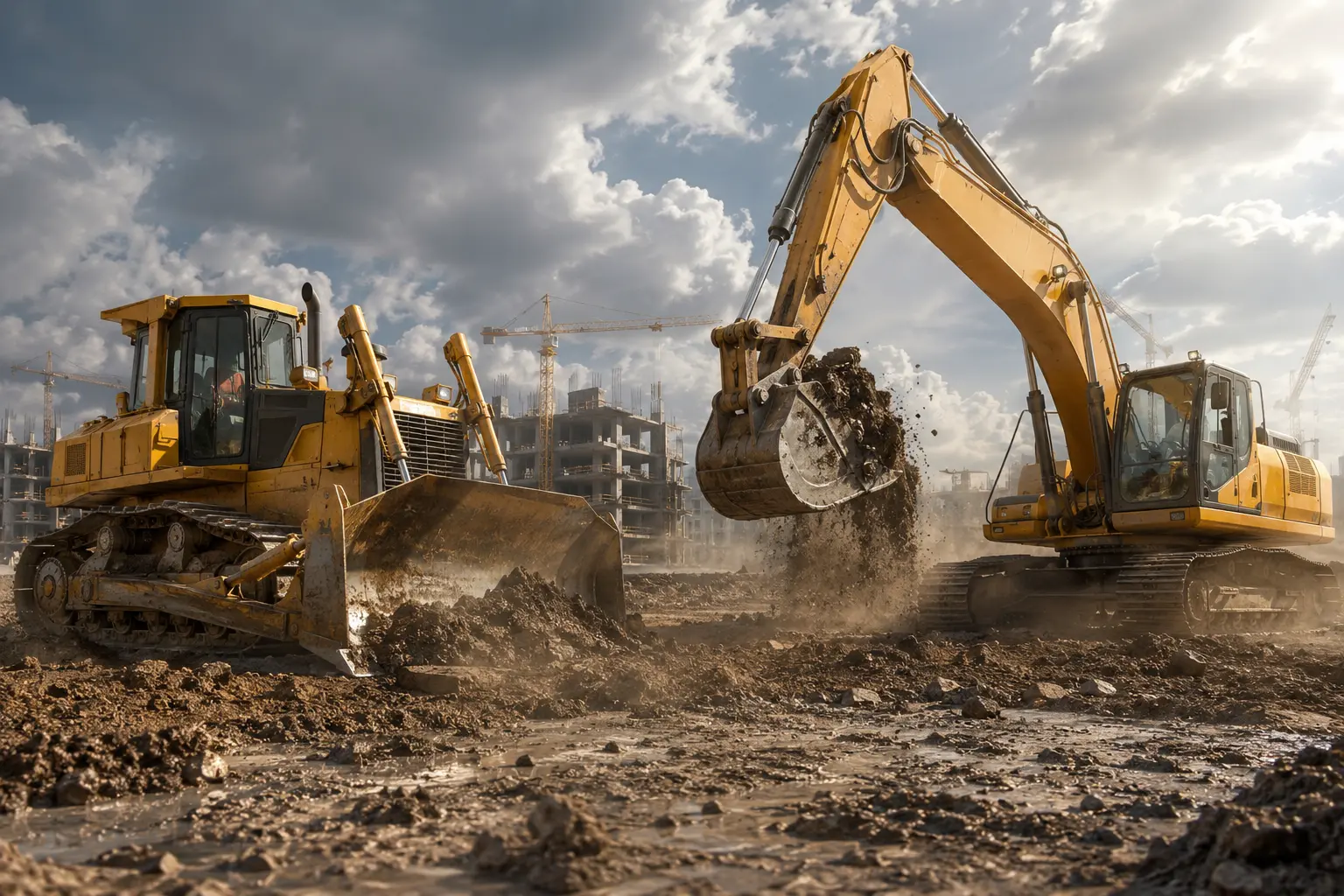
Heavy-duty machinery is essential for conducting construction, mining, road building, and other important infrastructural projects. Among them, the most common on a construction site include bulldozers and excavators. While these pieces of machinery may appear to be quite similar because they can carry out tough tasks, there are some significant differences between them.
Besides the size of the task at hand, choosing the right machine depends on efficiency, effectiveness, costs involved, and duration of the job. Although a bulldozer is useful for flattening the soil surface, the excavator is the most suitable machinery for any activity that requires deep excavation.
It is therefore very crucial to know the features of these two machines to choose the appropriate machine that would help you complete your task. In this blog, you will learn about the differences between bulldozers and excavators and what each of them can do.
Key Takeaways
Here are the most crucial things that you will learn from this comparison guide:
- Understand some of the basic differences between bulldozers and excavators in terms of design, function, and application.
- Which machine is more efficient for work such as digging, grading, demolition, clearing, and carrying large masses of soil.
- Identify the pros and cons of each machine so you do not make a mistake and buy the wrong machine.
- Observe the differences in how these machines operate, their mobility, efficiency, and maintenance.
- Get useful information about when you need a bulldozer, when it is better to use an excavator, and when both are required.
Understanding a Bulldozer
A bulldozer is an immense and heavily used piece of equipment. In essence, it is used to push, level, grade, and remove large masses of soil, sand, gravel, rocks, or other material in its path. Bulldozers are equipped with a huge blade on their front end for moving materials around a work site efficiently.
Unlike excavating machines that have only one purpose of digging, bulldozers are designed in such a way as to move loads to alter landscapes. This is achievable because of the bulldozer’s low center of gravity, wide tracks, and massive traction.
Typical places where bulldozers are found include:
- Construction sites
- Highway and road constructions
- Mining sites
- Quarries
- Land clearance
- Agricultural and forestry activities
- Infrastructure development sites
- Site preparation
Bulldozers are also fitted with GPS grading systems, hydraulic blades, and fuel-efficient engines, among others.
Main Components of a Bulldozer
Several key parts that constitute a bulldozer, and how they work together, affect the overall operation of the equipment.
Front Blade
The blade is the main part responsible for the machine’s operation and can be used to cut and move materials to other locations. The blade pushes soil, gravel, rocks, and debris during surface leveling. Due to the nature of the work, the operator may select between a straight blade, universal blade, or semi-universal blade.
Heavy-Duty Tracks
Bulldozers are equipped with steel tracks that spread the machine’s weight evenly. This ensures enhanced grip capability, reduced ground pressure, and stable operation on loose or uneven terrain.
Powerful Diesel Engine
The engine mainly produces high torque, which allows the bulldozer to exert huge force on the material and move it without losing original power. This way, it can push enormous loads continuously without any deterioration in performance.
Ripper Attachment
Most bulldozers come with a rear-mounted ripper that has one or several shanks. Such an attachment loosens very hard soil, frozen ground, asphalt, or rock before the main digging operation.
Hydraulic System
The hydraulic cylinders facilitate controlling the height, tilt, and angle of the blade with great precision. This feature empowers the operator to fine-level and move the material at the same time.
Common Uses of Bulldozers
Bulldozers are the most versatile machines available in the earthwork field. Their capacity to shift large masses means they are almost indispensable in many sectors.
Land Clearing
They cut vegetation and remove stumps to clear the site rapidly, preparing it for construction or to start an agricultural endeavor.
Site Preparation
They make full use of their potential when they level rough ground, remove barriers, and clear the way for laying stable foundations for building or development projects.
Road Construction
These heavy machines spread soil, level land, and complete the subgrade before the road surfacing is done.
Mining Projects
In mining, bulldozers are mainly used to remove or move topsoil, maintain and improve haul roads, prepare working areas, and manage stockyard operations efficiently.
Waste Management
Bulldozers help cover and flatten waste at landfills and also keep the working surface smooth.
Forestry Projects
Bulldozers help establish forest roads, clear out forests, and ready the ground for planting or preservation activities.
Understanding an Excavator
An excavator is one type of heavy machinery that uses hydraulic technology. The excavator can be used to dig, lift, trench, demolish, and handle materials. In contrast to the bulldozer that pushes materials horizontally on the ground surface, the excavator works vertically.
The key characteristic of an excavator is its ability to turn its upper part 360 degrees. This enables excavator operators to dig, fill trucks, move materials, demolish materials, and perform other functions without moving the whole equipment.
Some areas where excavators are applied include:
- Construction of buildings
- Installation of utilities
- Pipeline projects
- Construction of roads
- Mining
- Demolition
- River dredging
- Landscape works
- Quarrying
The range of applications of excavators is even broader with the use of interchangeable equipment.
Main Components of an Excavator
Having a basic understanding of the key parts of an excavator helps you understand how it handles delicate work.
Boom
Raising the boom to the desired height helps an excavator place its arm and bucket accurately while performing operations like excavation and lifting.
Arm (Stick)
Linked to the boom is the excavator’s arm, which digs at greater depths, allowing operators to reach ground layers and excavate in trenches efficiently, and is also used as an extension during digging operations.
Bucket
The digging action is carried out primarily by the bucket, which also scoops, trenches, and loads. Depending on the application, a range of sizes, shapes, and designs are available for buckets.
Rotating House
By turning the upper frame 360 degrees, operators can excavate easily without needing to shift the lower part of the machine.
Hydraulic System
Mechanization of each movement, such as lifting, digging, rotation, and attachment operation, is handled by robust hydraulic cylinders.
Undercarriage
Tracked or wheeled undercarriage options for excavators are supplied as required, based on topography demands as well as transport needs.
Common Uses of Excavators
Excavators are used in jobs where precision, depth, and lifting capability are needed.
Trenching
Excavators can excavate various types of buried utility pipes, drainage systems, electrical cables, and water mains. Their level of accuracy in this activity is outstanding.
Foundation Excavation
They dig out the earth from the site to make foundations for buildings, basements, retaining walls, and structural footings.
Demolition
Safety-first is the main concern during building and concrete structures demolition. With the aid of hydraulic breakers or demolition attachments, excavators carry out such risky tasks of dismantling buildings and bridges.
Material Handling
Excavators equipped with special attachments like grabs, bucket lifts, etc. are used to carry different types of construction materials from one place to another on a construction site. These materials include heavy-duty pipes, steel bars, concrete blocks, etc.
Mining and Quarrying
They dig out minerals and load trucks. They clear ground overburdens and support other operations in a quarry.
Landscaping
Terrain reshaping, pond digging, and drainage system installation are some of the major roles excavators perform in landscaping projects. They will also assist with large-scale landscaping work.
Difference Between a Bulldozer and Excavator: Brief Overview
To better understand how bulldozers and excavators differ from one another, review some of the differences in their features.
| Feature | Bulldozer | Excavator |
| Primary Function | Pushing, grading, leveling | Digging, lifting, trenching |
| Main Attachment | Front blade | Boom, arm, and bucket |
| Movement | Tracks | Tracks or wheels |
| Rotation | Fixed front-facing operation | 360-degree rotating house |
| Best For | Land clearing and earthmoving | Excavation and material handling |
| Digging Capability | Limited | Excellent |
| Surface Leveling | Outstanding | Moderate |
| Lifting Capability | Minimal | Excellent |
| Demolition Work | Limited | Excellent with attachments |
| Precision | Moderate | Very High |
Bulldozer vs Excavator: Comparative Analysis
Despite the similarity of these machines in the earthmoving category, they were made to do different tasks on a construction site. This comparison is expected to help contractors work more efficiently and save money on renting and buying construction machinery.
1. Primary Functions
First, each machine has its own unique purpose.
The bulldozer is constructed for pushing, spreading, and leveling large amounts of soil, gravel, sand, and any other bulk materials. The machine can transport materials from one place to another with the help of its blade; that is why it is used for grading.
The excavator is created for digging, lifting, and loading. The machine has an arm and bucket, which makes it ideal for excavating and trenching work, as well as foundation work.
Winner: It depends on the task. Bulldozers excel at pushing and leveling, while excavators dominate digging and lifting operations.
2. Working Mechanism
In operation, a bulldozer advances and uses its front blade to move material. Its blade height, blade tilt, and blade angle can be adjusted via hydraulic controls for accuracy during grading.
A good example of a machine that uses a hydraulic boom, stick, and bucket to dig beneath the ground, lift, and transfer material is the excavator. It is also more flexible due to its rotating upper body so that one does not need to move the entire machine.
Winner: The excavator is more versatile, but the bulldozer is more efficient at moving earth on the surface.
3. Earthmoving Capability
Another important advantage of the bulldozer is its ability to transport massive amounts of earth with ease. With their wide blade at the front end and robust engines, bulldozers are designed to transport earth materials such as soil, gravel, stones, and other debris over a construction site. Track undercarriages provide good traction for efficient operation on any kind of terrain.
The difference between an excavator and a bulldozer is that the former does not move earth but only digs earth using the hydraulic bucket and dumps the soil in trucks or stockpiles it. The excavator is quite efficient when it comes to excavation, but it was not built for transporting earth.
Winner: The bulldozer wins in terms of earthmoving and transportation capabilities.
4. Digging Performance
As far as digging is concerned, excavators are specially made machines that can provide excellent digging performance. Their hydraulic boom, stick, and bucket make it easy to dig trenches, foundations, remove underground material, and do accurate earthwork. They also work effectively at various depths and angles; thus, they are ideal for many types of excavation work.
On the other hand, bulldozers are not meant for deep digging because their front blade is used for scraping and leveling the land. Even though some of them have a rear ripper for breaking down compacted soil or rock, they do not have the ability of excavators when it comes to digging, reach, and accuracy.
Winner: Excavator is the clear choice for excavation, trenching, and foundation work.
5. Precision and Control
Precision plays a major role in many construction activities, particularly in situations where the activity is performed near underground utility lines and other structures. This is due to the high level of precision that can be achieved through the use of hydraulics and the articulation of the excavator boom.
On the other hand, the bulldozer is better suited to moving large amounts of material rather than making precise maneuvers. Even though an experienced operator can get good results grading with bulldozers, they cannot achieve the required precision for construction and excavation activities.
Winner: The excavator provides greater precision and control for construction and excavation activities.
6. Performance on Rough Terrain
Rough terrain is prevalent in construction sites where muddy ground, rocks, slopes, and unstable conditions are present. Bulldozers are designed to handle rough terrain, thanks to the steel tracks that provide excellent traction and stability.
Tracked excavators perform excellently in rough terrain; however, they are more stable when carrying out excavation tasks rather than transporting heavy weights across rough terrain.
Winner: Bulldozers function effectively in rough terrain requiring excellent traction and stability.
7. Lifting Capacity
The capacity of excavators is relatively high. It enables them to hoist and set loads such as concrete pipes, steelwork, prefabricated loads, and construction equipment using the hydraulic arm and boom. Using suitable attachments, the excavator can be used in specialized lifting and setting of loads at a construction site.
The bulldozer does not have any lifting capacity. This is because it is designed with a front blade that is used for pushing and grading loads.
Winner: The excavator is the better choice for lifting, loading, and material handling applications.
8. Productivity in Site Preparation
Site preparation includes activities such as vegetation removal, clearing debris, grading the surface, and ensuring the site is ready for construction. Bulldozers are very productive machines since they are built to move materials on the ground at high speed.
Excavators may help greatly with site preparation, since they can be used to remove tree stumps, rocks, and other underground barriers before grading the land. After the completion of the oval of barrier removal, grading can proceed quickly.
Winner: Bulldozers deliver higher productivity for land clearing, grading, and overall site preparation.
9. Versatility of Attachments
Excavators are among the most versatile pieces of construction machinery because they can easily attach interchangeable attachments. This means that, using the same excavator and simply attaching various attachments, the operator can perform different kinds of work without additional machinery.
There is a large number of excavator attachments, including:
- Hydraulic breakers used for demolition of concrete and rocks.
- Grapples used for handling logs, scrap metal, and large-size material.
- Augers used for drilling precise holes in foundations, fences, and utility poles.
- Compactors used for soil stabilization and trench compaction.
- Hydraulic shears used for steel structure demolition.
- Thumb attachments used to improve gripping capacity.
- Different types of buckets used for various work, including digging, trenching, leveling, and ditch cleaning, increase the versatility of bulldozers. Still, they are limited to only two kinds: front blade and rear ripper.
Though such attachments increase the earth-moving capabilities of bulldozers, they are not as versatile as attachments of an excavator. It stands out as the more versatile machine thanks to its extensive range of specialized attachments.
Advantages of a Bulldozer
The bulldozer is still one of the best pieces of equipment in large-scale earth-moving operations due to its strength, toughness, and simplicity. Some of its main benefits include:
- High push force for quick movement of large amounts of soil and waste material.
- Precision in the process of leveling roads, foundations, and construction sites.
- Tough traction that enables efficient operation on soft, rocky, and hilly surfaces.
- Durable construction intended for tough and continuous operation.
- High efficiency in clearing land from vegetation and other obstructions.
- Attachments for ripping the soil before excavation.
- High efficiency in mining, quarrying, and forestry projects.
Limitations of a Bulldozer
Even though they are strong, bulldozers do not fit into all situations. Their limitations are as follows:
- Inability to do deep digging work.
- Low lifting ability.
- Not many attachments are available, unlike in excavators.
- They are not useful in cramped construction in cities.
- Poor precision for utilities and foundations.
Advantages of an Excavator
Excavators are extremely versatile machines that can carry out several construction activities apart from excavating. Advantages include:
- Deep and precise digging for foundations, trenches, and basements.
- Strong hydraulic lifts for heavy items and machines.
- Rotation at a 360-degree angle to enhance efficiency and minimize positioning.
- Attachments that make the job site versatile.
- Effective loading of trucks and transportation of materials.
- High efficiency in demolishing work and work in constricted spaces.
- Accurate control for jobs involving meticulous digging.
Limitations of an Excavator
There are certain limitations of an excavator too. Some of these are:
- Not as fast at moving large amounts of material over distance.
- Poor efficiency in large-scale grading and leveling.
- Higher maintenance of hydraulics.
- Stability needs to be taken into account while lifting.
- Need for additional machines to do complete site preparation.
How to Choose the Right Machine for Your Project
Before you make up your mind regarding whether to opt for a bulldozer or an excavator, there are numerous factors to be considered. By taking all these factors into account, you will improve efficiency and save money.
Nature of the Project
Before you make up your mind regarding whether to opt for a bulldozer or an excavator, there are numerous factors to be considered. By taking all these factors into account, you will improve efficiency and save money.
Terrain Conditions
Consider what kind of surface your machine will have to work on. A bulldozer is highly effective on wet, rough, and uneven ground, but an excavator can be more useful in certain conditions.
Project Size
In addition, the size of your project plays a role in choosing equipment. Small-scale work might require just one machine, but larger projects in construction and mining industries require both machines.
Material Handling Needs
If you require a machine that can lift heavy material or load trucks, then you should go for the excavator. If pushing, spreading, and moving lots of soil or waste material is the task at hand, then a bulldozer will be more efficient.
Budget and Long-Term Costs
Consider more than the cost of purchasing the machines and look into the cost of fueling and maintaining them. The bulldozer will be cheaper to operate for tasks involving continuous earthmoving.
Why Buy from Big Boss Machines?
Choosing the best supplier of equipment is important for efficiency, productivity, and profitability in each job. Big Boss Machines provides a wide range of heavy construction and earthmoving equipment for any type of construction, mining, infrastructure, and industrial work.
Wide Range of Heavy Equipment
The variety of bulldozers and excavators gives you the right machine for any job.
Reliable Quality and Performance
All machines are manufactured using quality materials and advanced technology, making them reliable and fuel-efficient for difficult working conditions.
Expert Assistance and After-Sales Support
With professional advice, you can easily choose equipment and spare parts to help reduce downtime.
Whether it’s land clearing and grading, excavation, trenching, or heavy-duty earthmoving, Big Boss Machines has the reliable equipment solutions that can fulfill the demands of today’s job sites.
Conclusion
These two machines play an important role in the construction and earth-moving industry. But their functions differ: a bulldozer is employed to push, grade, level, and clear the ground, whereas an excavator is employed to dig, trench, lift, demolish, and move materials accurately.
It wouldn’t be wise to focus on finding out which equipment is better. Rather, you need to know which piece of equipment is more suitable for you in your project.
Frequently Asked Questions!
The major difference comes from what each of them is meant to do. A bulldozer is meant to push and grade materials in the soil, while an excavator is meant to dig, trench, lift, and demolish using a hydraulic boom and bucket.
A bulldozer would be more appropriate in such a case because it can move debris such as plants, rocks, and soil, making the ground flat.
No, because even though an excavator carries out the functions of grading and clearing, it is slower than the bulldozer in terms of movement and leveling of materials.
An excavator is the most appropriate machinery for the job as it offers better depth and precision as well as hydraulic power for digging.
Yes. The two machines work hand in hand on many construction sites, where the excavator digs the ground while the bulldozer grades.