
Material handling is crucial in any industry. Whether it’s transporting raw materials from the warehouse, moving large machines at the construction site, loading containers at the port, or stacking products in the logistics center, these operations can be carried out faster, more safely, and more cheaply with the help of material handling equipment.
If there is no efficient material handling equipment (MHE), organizations are doomed to slow processes, incur costly labor, experience workplace injuries, damage to products, and inefficiency. With the right equipment, one can make the entire process easy and deliver the project on time.
Contemporary construction, logistics, warehousing, manufacturing, mining, port, agricultural, and infrastructure industries cannot compete without MHE.
This guide will provide you with information on the importance of material handling equipment, the various types of equipment, their benefits, uses across different industries, and ways to choose a reliable supplier to achieve high returns on investment.
Key Takeaways
This summary outlines the importance of appropriate material-handling equipment, including forklifts, reach trucks, pallet jacks, and tippers, in increasing efficiency, safety, and operational cost savings across industries.
- Material handling equipment increases workplace efficiency by reducing manual effort and streamlining processes.
- Modern equipment enhances employee safety and prevents workplace accidents.
- Various industries need special machines to move and transport loads.
- The choice of equipment depends on such parameters as load capacity, environment, terrain, lifting height, and other operational characteristics.
- Using proper equipment leads to cost savings on maintenance.
- At Big Boss Machines, you will find a wide variety of high-quality material-handling equipment perfect for construction, logistics, warehouses, ports, mining, and industrial applications.
What is Material Handling Equipment?
Material Handling Equipment refers to machinery used to lift, move, transport, stack, store, arrange, and efficiently handle materials. These machines help reduce manual handling and improve the speed, safety, and accuracy of material movement in an industrial environment.
Instead of relying entirely on manual labor, companies use specialized machines to move bulky, large-sized materials with greater accuracy. This may be related to the movement of pallets within the warehouse or the movement of construction materials on-site. The use of MHEs in businesses will result in the following benefits:
- Faster movement of materials
- Reducing manual labor
- Improving workplace safety
- Increasing efficiency
- Decreasing operational costs
- Handling heavier materials accurately
From small-scale warehouses to construction sites, port operations, and mining operations, material handling equipment plays an essential part in optimizing daily operations.
Importance of Material Handling Equipment in the Current Era
In today’s era, as business organizations grow at a faster pace, companies face limited timeframes, higher customer expectations, rising labor costs, and stiff competition. Material handling is important to ensure productivity and the accomplishment of organizational objectives.
Material handling equipment helps companies transport and organize their materials without requiring any physical effort. With the help of task automation, organizations can get work done faster. The significance of material handling equipment is that:
Improved Productivity
The modern machinery used in material handling completes jobs within minutes that would have taken several people and several hours to complete manually. Loading, unloading, lifting, and moving become faster, helping companies maintain their production processes.
Workers will be able to lift and transport many loads at once, thus making work more productive not only in warehouses but also in factories, construction sites, and logistics centers. This increases the efficiency of using machinery.
Enhanced Workplace Safety
Handling heavy loads manually is one of the major causes of injury among industrial workers. The use of specialized equipment such as forklifts, telehandlers, and loaders reduces strain on workers and ensures the safe lifting of heavy materials. These devices really help decrease the likelihood of:
- Backaches
- Strained muscles
- Materials falling on workers
- Accidents involving equipment
- Overworked workers
Besides a safer environment, a workplace with fewer risks can also enjoy benefits like fewer interruptions in operations, lower workers’ compensation, and increased employee trust and morale.
Lowering Operational Expenses
Despite investing initially in material handling equipment, companies can usually make back their money by becoming more productive and reducing their costs. Today’s machines enable easier handling of the workload and, at the same time, perform tasks faster and with higher precision.
A few cost-saving benefits are:
- Less labor costs
- Projects can be finished quicker
- Materials are less likely to be damaged
- Better fuel economy
- Decreased equipment breakdowns
Besides these, dependable equipment can also help delay significant repairs through timely servicing or better diagnostics, thereby leading to higher profitability over time.
Better Inventory Management
Efficient inventory management largely depends on how quickly and accurately materials can be moved and stored. With the help of material handling equipment, warehouses can not only use their storage space to the fullest but can also keep products organized and accessible without any hassle.
Working staff will be able to:
- Properly arrange materials in stacks
- Quickly get to the required inventory
- Use storage space more effectively
- Lower the risk of product damage
- Perform better order fulfillment
And all of these contribute to making warehouse operations more efficient, with smoother, faster dispatch times leading to enhanced customer satisfaction.
Types of Material Handling Equipment from Big Boss Machines
Big Boss Machines provides its clients with an extensive range of high-quality material handling equipment aimed at increasing their productivity in construction, warehousing, logistics, mining, manufacturing industries, and other areas of operation. Each type of machine is specifically developed for performing particular functions with reliability in challenging environments.
1. Forklifts
Forklifts have been identified as among the most commonly employed material handling equipment in the warehouse, manufacturing plant, port, logistics company, and construction site industries. Forklifts have the ability to lift, move, stack, and unload loads efficiently, thereby reducing the need for manual work.
Big Boss Machines provides its clients with several models of forklifts for different purposes, such as:
- Diesel Forklifts
- Electric Forklifts
- LPG Forklifts
- Rough Terrain Forklifts
- Heavy-Duty Forklifts
Typical Uses:
- Warehouse operations
- Manufacturing facilities
- Distribution centers
- Construction sites
- Shipping facilities
- Retail logistics
Forklifts increase the efficiency of loading/unloading operations and optimize warehouse capacity.
2. Telehandlers
Telehandlers combine the lifting capabilities of a forklift with the extended reach of a crane. This combination makes them perfect for construction and other industries, where their telescopic boom can be used to perform tasks at elevated heights or in places that are difficult for regular forklifts to reach.
They work exceptionally well outdoors on surfaces such as rough, uneven ground, as well as on large job sites where changes in equipment are unavoidable.
Best Uses:
- Building construction
- Steel structure installation
- Agriculture
- Infrastructure projects
- Warehousing
- Industrial maintenance
In addition to regular telehandlers, some models allow you to mount two or more attachments, letting you use a single machine for different lifting and handling tasks.
3. Wheel Loaders
Wheel loaders are among the toughest machines and are engineered for loading, carrying, and transporting loose materials, up to high volumes, quickly and efficiently. Thanks to their large-capacity buckets and powerful engines, these machines are the best for moving material for short distances.
They are mostly utilized in:
- Construction
- Mining
- Aggregate handling
- Quarry operations
- Road development
Wheel loaders can efficiently load, unload, and transport various materials such as sand, gravel, crushed stone, soil, etc., which are in bulk form, thereby increasing the level of work efficiency on very demanding projects.
4. Skid Steer Loaders
Skid steer loaders are small, highly maneuverable machines capable of performing various material-handling tasks in tight spaces. Their compatibility with different attachments makes them extremely adaptable machines suitable for small to medium-sized projects.
Typically, they’re involved in:
- Materials loading
- Site cleaning
- Landscaping
- Picking up and disposing of debris
- Working on small construction sites
The operators’ ability to use the machines in spaces where larger equipment would have difficulty maneuvering is enabled by the machines’ small size.
5. Excavators
While excavators are mainly recognized for their ability to dig, they can also be very effective at material handling when equipped with the right tools, such as grapples, buckets, or lifting hooks. They can lift, load, and place heavy materials with great accuracy.
They provide support in:
- Handling heavy items
- Truck loading
- Demolition debris management
- Installing pipes
- Moving rocks
Mini excavators and large ones both serve as functional tools for various projects, from residential construction to large-scale infrastructure development.
6. Backhoe Loaders
Backhoe loaders feature both a front loader bucket and a rear excavator arm, so users can excavate, load, lift, and transport materials with just one machine. That flexibility makes them a very economical option for contractors performing various operations.
Great for:
- Utility projects
- Municipal work
- Small construction projects
- Road maintenance
- Agriculture
Being able to transfer from one operation to another (e.g., from digging to loading) contributes to the efficiency of the work performed. And the number of machines is greatly reduced, thereby minimizing overall equipment costs.
7. Bulldozers
These are heavy-duty vehicles designed chiefly to push spread level and clear very large volumes of materials. Although generally connected to earthmoving, bulldozers are also quite indispensable in material handling by way of quickly moving soil, debris, and other construction materials around the working areas.
The diverse range of tasks they are used for includes:
- Land clearing
- Site preparation
- Road construction
- Mining
- Infrastructure development
With the use of their sturdy blades and ample traction, they are able to complete the assigned tasks under difficult working conditions as well.
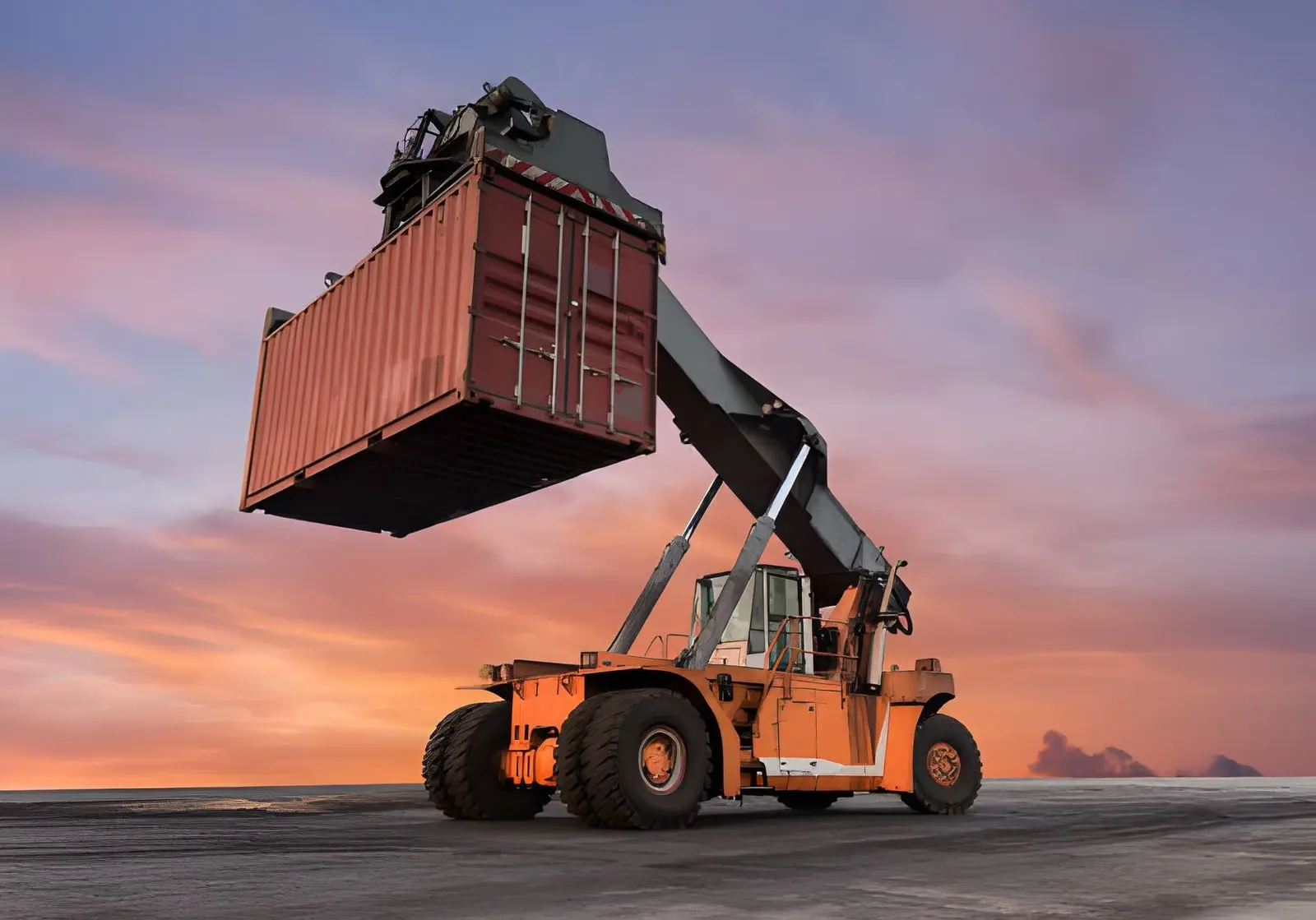
8. Reach Stacker
A reach stacker is a machine designed to lift, transport, and stack shipping containers in a logistics environment. Its great lifting ability and flexibility make the reach stacker an effective solution for container handling.
They are often applied at:
- Shipping ports
- Container terminals
- Freight yards
- Logistics centers
Reach stackers increase the efficiency of freight yards by providing the possibility for quick and safe movement of containers with full usage of storage space.
9. Empty Container Handler
An empty container handler is the machine that is designed for the transport and stacking operations of empty shipping containers. The specialized design of this equipment allows for excellent stacking capability without compromising maneuverability or stability.
Empty container handlers provide:
- Great stacking capability
- Good maneuverability
- Quick container movement
- Space utilization
These machines are irreplaceable for handling large numbers of empty containers at ports and container terminals.
10. Tow Tractors
Tow tractors are, to be exact, built to move trailers, carts, or other heavy objects, even several at once, around a large area. They offer a really good way to transport goods over long distances without having to do manual loading and unloading repeatedly.
Some places where they regularly operate:
- Airports
- Warehousing
- Factories
- Distribution centers
By towing multiple loads simultaneously, tow tractors streamline internal logistics, reduce transportation time, and increase operational efficiency.
Industries That Rely on Material Handling Equipment
Material handling equipment matters a lot in construction site operations by simplifying not only quick transfers but also safe lifts and effective task scheduling.
Construction
Construction works need a continual movement of various materials like machinery, tools, and equipment from one place to another as the development progresses. Material handling equipment allows contractors to move heavy materials easily and safely while minimizing manual labor.
Typically handled materials include:
- Steel
- Concrete
- Bricks
- Pipes
- Machinery
- Building materials
Good-quality tools can help projects finish on time and increase productivity on site.
Warehousing and Logistics
Contemporary warehouses are handling thousands of goods daily, so the efficient movement of materials has become a must. Using forklifts, tow tractors, and reach stackers, the workers can transfer inventory between storage areas and between loading docks and transport vehicles with speed and precision.
As a result, inventory management is enhanced, order fulfillment is accelerated, and operational delays are minimized.
Manufacturing
Material handling equipment is one of the mainstays of manufacturing plants, transporting materials through production lines and moving finished goods to storage or shipping areas. Keeping production running without a hitch is most effectively ensured by an efficient material flow; besides, it improves the factory’s overall efficiency.
Mining
Mining units require powerful machines that can deal with very heavy materials and other arduous working conditions. Apart from facilitating the movement of ore, rocks, and other materials, wheel loaders, excavators, bulldozers, heavy-duty forklifts, etc., also help to raise operational safety and productivity.
Ports and shipping
Ports and shipping terminals are largely reliant on specialized machines for the rapid and efficient movement of containers. Reach stackers and empty container handlers are instrumental in maximizing storage capacity, reducing turnaround times, and maintaining smooth cargo-handling operations, among other things.
How Material Handling Equipment Improves Business Performance
With improved material-handling processes and reduced reliance on human labor, material-handling equipment impacts productivity, efficiency, safety, and operational costs.
Faster Project Completion
Equipment enables much faster material loading, unloading, lifting, and transportation. Thus, businesses will have more time to manage more tasks without delays.
Reduced Product Damage
Manual handling is associated with increased risks of damage. Modern material handling equipment guarantees safe and secure movement of goods from one place to another.
Effective Use of Resources
Material handling equipment makes it possible to manage all heavy-duty operations that require several workers with the help of only one machine. Thus, employees will be able to perform other tasks.
Greater Versatility of Equipment
A lot of modern material handling machines allow for attaching different tools to them. It means that such a machine can perform several tasks at once.
Factors to Consider Before Choosing Material Handling Equipment
When choosing material handling equipment, it is important to consider your operational requirements, work environment, and your business’s future plans. Choosing the right equipment will increase efficiency, reduce maintenance costs, and lower operational risks.
- Load Capacity: You should always choose equipment that can safely handle your load requirements. Insufficient equipment will affect your productivity and safety in the workplace.
- Working Environment: The equipment used indoors, at outdoor construction sites, at ports, in factories, and mines will be different because of different environmental conditions.
- Terrain: The state of the floor greatly influences the choice of equipment. You will need other machines for smooth warehouse floors than those used in construction sites or mining areas.
- Lift Height: If you need to stack goods at high places, such as on the shelves, choose the equipment that allows lifting the load to sufficient heights.
- Fuel Type: You have to decide whether to use diesel, electric, or LPG engines based on operating time, emissions requirements, fuel availability, and the cost of running.
- Maintenance Requirements: Equipment with reliable components, easy maintenance, and spare parts will reduce downtime.
Why Choose Big Boss Machines?
It is as important to choose a supplier as it is to choose the equipment itself. Big Boss Machines offers various machines for different purposes of material handling in industries like construction, logistics, warehousing, mining, manufacturing, agriculture, and ports.
There are several reasons why companies prefer Big Boss Machines:
- Wide Range of Machines: From forklifts to telehandlers, wheel loaders, skid steer loaders, excavators, backhoe loaders, bulldozers, reach stackers, empty container handlers, and tow tractors, there are many machines to suit your application.
- Renowned Machinery Brands: You can get machinery that comes from reputable brands famous for their quality and performance.
- Machines for Various Industries: Whatever industry you belong to, there will be a machine suited for your requirements.
- Top-Notch Machines: Designed to perform efficiently and effectively under any working conditions.
- Professional Assistance in Selection of Equipment: They can guide you through the selection of appropriate equipment.
- Supportive After-Sales Service: Continuous support and assistance to keep your machinery in excellent condition and increase productivity.
Big Boss Machines, with its emphasis on quality, reliability, and customer satisfaction, can be relied upon by businesses wanting to make their material handling processes more efficient.
Final Thoughts!
The use of material handling equipment is increasingly becoming an indispensable investment for companies that aim to achieve productivity, safety, and efficiency. Whether it is a forklift, telehandler, wheel loader, excavator, backhoe loader, bulldozer, reach stacker, empty container handler, skid-steer loader, or tow tractor, each piece of machinery plays a role in optimizing material movement.
Selecting appropriate material-handling equipment will not only speed up the process but also lower labor costs, reduce material loss, and ensure safety on the job site. With the development of industries and increased demands on them, material handling solutions will play an important role in remaining competitive. Choosing high-quality equipment from Big Boss Machines will help overcome any business challenge, today and in the future.
Frequently Asked Questions!
Material handling equipment refers to the devices that are used for lifting, transporting, loading, unloading, stacking, and moving materials effectively in warehouses, construction sites, manufacturing facilities, logistics hubs, ports, and industries.
These are important because they increase productivity, reduce manual labor, make workplaces safe, minimize material damage, reduce operating costs, and help businesses perform better.
The construction industry, logistics industry, warehousing, manufacturing industry, mining industry, agriculture, infrastructure development, shipping ports, distribution centers, and other industries utilize material handling equipment.
Think about factors like load-carrying capacity, lift height, terrain, work environment, power source, operational specifications, maintenance requirements, and the specific materials you want to move when selecting your equipment.
Big Boss Machines offers a wide variety of material-handling equipment, including forklifts, telescopic handlers, wheel loaders, skid-steer loaders, excavators, backhoe loaders, bulldozers, reach stackers, empty container handlers, and tow tractors.